Guide
Best Time to Get Pregnant After Your Period
The best time to get pregnant after your period is usually not a single magic day. It depends on when you ovulate, how long your cycle is, and how regular your timing tends to be. This guide explains how to think about conception timing in a more practical and realistic way.
In this guide
⚡Quick Answer
- ✦The best time to get pregnant is usually in the days leading up to ovulation and the day ovulation happens.
- ✦That means the best time after your period depends more on your cycle length and ovulation timing than on one fixed day.
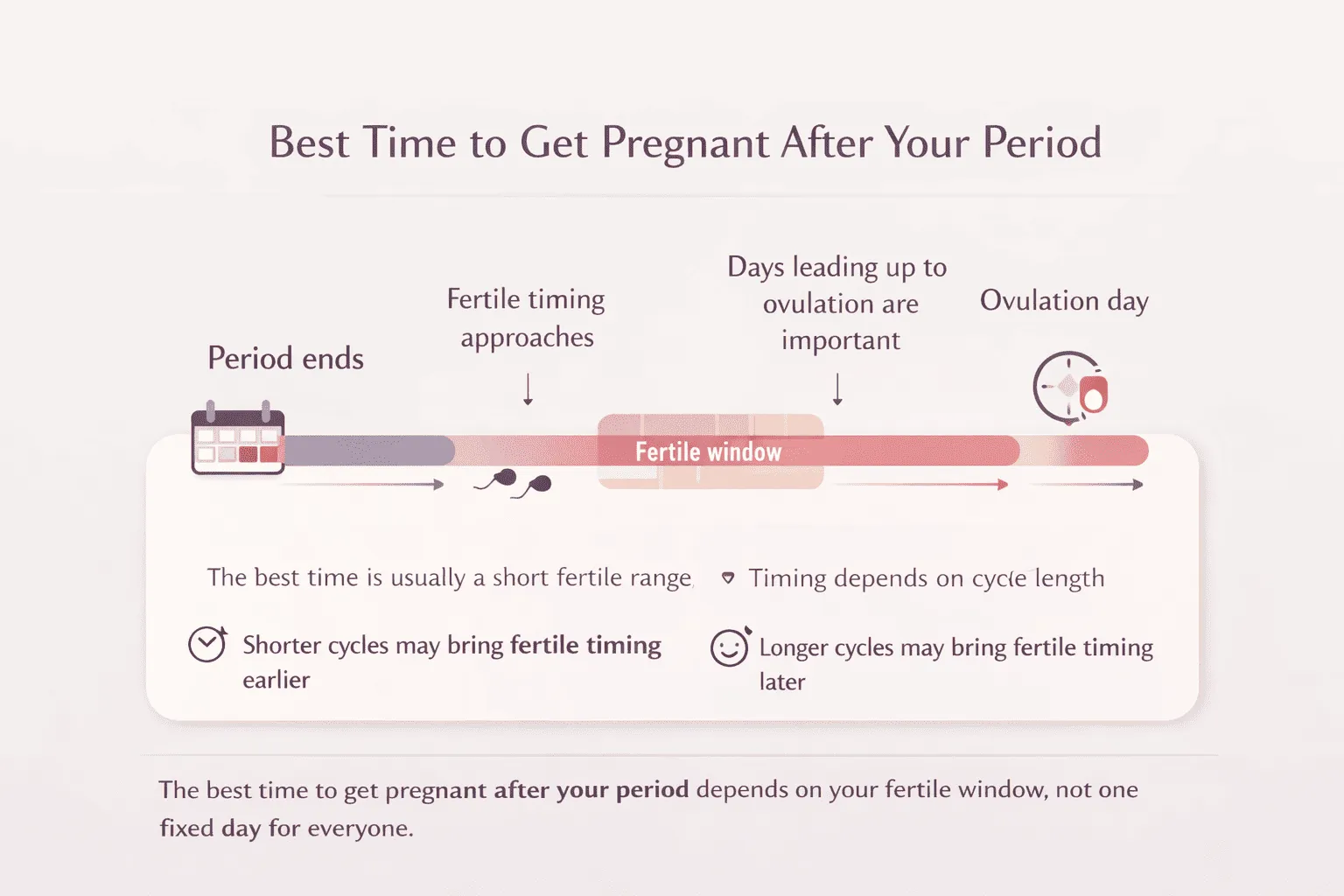
- ✦Shorter cycles can bring fertile timing earlier, while longer cycles can move it later.
Typical sequence of a cycle
Why there is no single best day for everyone
A lot of people want a simple answer like “day 10” or “day 14,” but conception timing does not work that neatly for everyone. The best time to get pregnant after your period depends on when you ovulate, and ovulation is shaped by your cycle length and how regular your cycles are.
"You always ovulate exactly 14 days after your period starts."
Ovulation usually happens 14 days before your next period begins, which changes entirely depending on your total cycle length.
That is why it is more accurate to think in terms of a fertile range rather than one universal day after bleeding stops.
✦ Examples by cycle length
Here is how your total cycle length directly shifts your fertile timing:
Fertile timing may arrive much earlier, sometimes shortly after bleeding ends.
Fertile timing often falls neatly around the middle of the cycle.
Fertile timing shifts later, meaning more days between your period and ovulation.
Want a more personalized estimate?
Use your specific cycle length to estimate your likely fertile timing with our private, interactive tools.
The best conception timing is built around ovulation, not just around when your period ends.
Trying only on one exact day can miss useful timing because sperm can survive for several days.
Shorter cycles can move your fertile days earlier, and longer cycles can move them later.
The most useful way to think about timing
Instead of asking for one best day after your period, it is more practical to ask: when is my likely fertile window this cycle? That is because conception is most likely in the days surrounding ovulation, especially the days before it and the day it happens.
↻ Regular Cycles
- ✦ Fertile timing is much easier to estimate.
- ✦ Digital calculators are often more useful when your cycle pattern is consistent.
- ✦ Your cycle averages provide a strong, reliable baseline.
〰️ Irregular Cycles
- ✦ Fertile timing is less predictable from dates alone.
- ✦ Looking at broad date ranges matters more than exact days.
- ✦ Tracking physical patterns (like cervical mucus) becomes essential.
Expert Tip: Don't wait too long
Sperm can survive inside the reproductive tract for up to 5 days. Because of this, having sex in the 2-3 days leading up to ovulation often results in higher pregnancy rates than waiting for the exact day of ovulation.
What most affects your best timing
- • your usual cycle length
- • whether your cycles are regular or irregular
- • your tracking history across recent months
- • thinking in a fertile range rather than one exact day
Why trying only on one predicted ovulation day can be too narrow
A common mistake is waiting for one exact “ovulation day” and treating it like the only day that matters. In reality, conception chances are often strongest across a short fertile range around ovulation. That is why a broader timing strategy is usually more practical than aiming at one calendar square.
Common mistakes & pitfalls
Understanding how timing works also means knowing what assumptions to avoid. Here are the most common pitfalls people encounter when estimating their fertile window.
Relying on one exact day only
Sperm can survive for days, making the days leading up to ovulation just as important as the day itself.
Ignoring cycle length differences
A 24-day cycle and a 32-day cycle will have entirely different fertile windows. Averages aren't universal.
Assuming everyone ovulates on Day 14
The 'Day 14' rule is an average based on a perfect 28-day cycle, which many women do not have.
Treating calculators as guarantees
Digital calculators provide mathematical estimates based on your past, not medical certainties about your future.
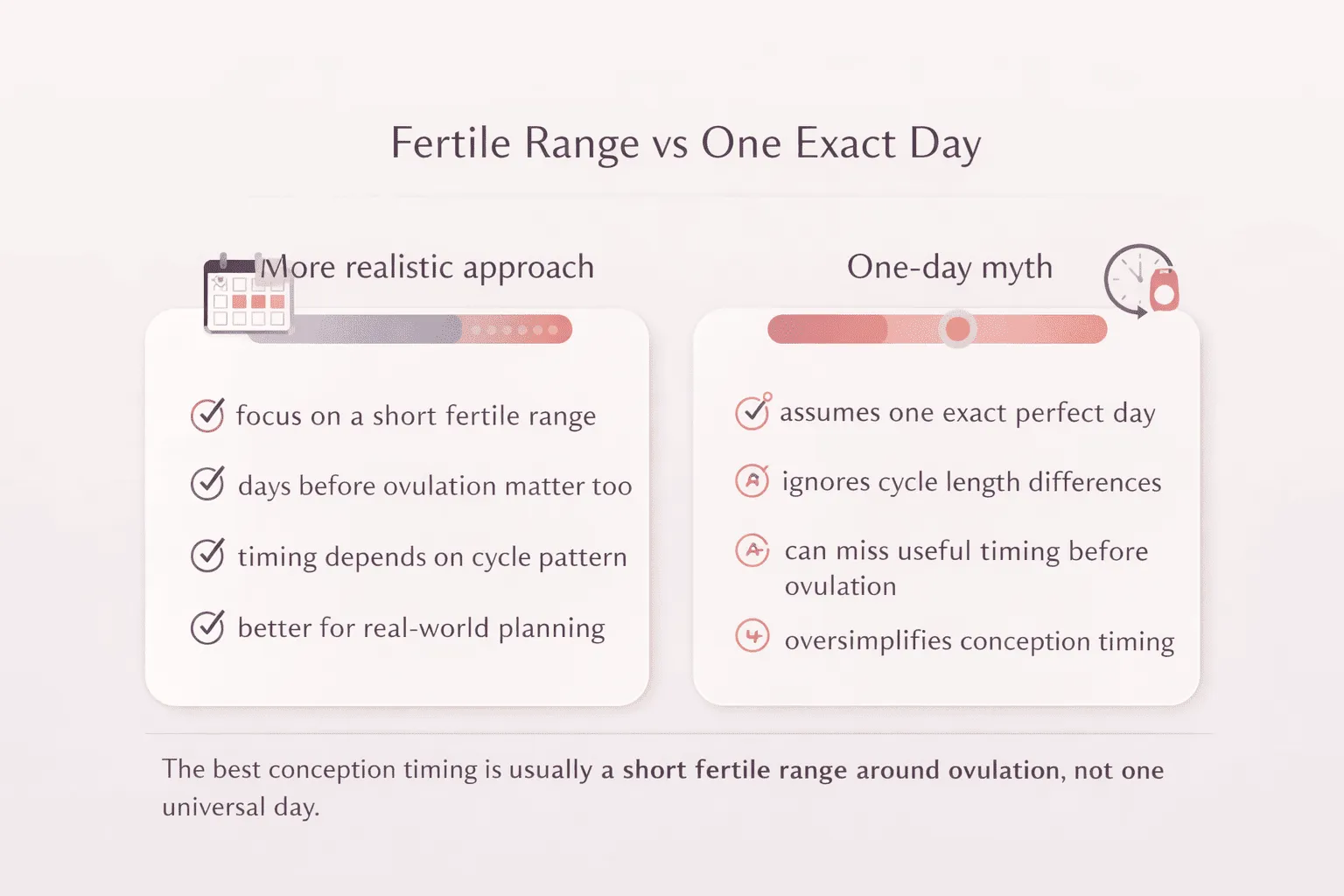
✓ More realistic approach
Focus on the short fertile range around ovulation, not only one predicted day.
✕ Less realistic approach
Assume one fixed day after the period will always be the best day for conception.
In simple terms, the best time to get pregnant after your period is usually a short window around ovulation, not one universal day that works for everyone.
How to use this information practically
Now that you understand how cycle length and the fertile range work, here is how to apply it to your own tracking to maximize your chances.
Track past cycles
Gather 3-6 months of dates to confidently find your true average cycle length.
Think in a range
Focus on a 5-6 day window leading up to ovulation, not just one exact day.
Use tool estimates
Let calculators do the math based on your averages to give you a baseline.
Watch for signs
Rely more on physical signs (like body temperature) if your dates vary wildly.
When to seek professional advice
If you have very irregular cycles, no clear cycle pattern, long-term difficulty conceiving, or sudden major cycle changes, calculator estimates may be less reliable. In these scenarios, personalized advice from a healthcare provider can offer much more clarity than digital estimates.
✦ Bottom line
The best time to get pregnant after your period is usually the fertile days leading up to ovulation and the day ovulation happens. The exact timing depends heavily on your unique cycle length, meaning thinking in a broader fertile range is always more useful than trying to pinpoint one fixed calendar day.
Use your cycle length to estimate your likely fertile window with our Fertile Window Calculator.
Helpful next steps
Stop guessing and start estimating with our private tools.
Frequently asked questions
These quick answers cover the most common questions people have when trying to understand the best conception timing after a period.
1What is the best time to get pregnant after your period?+
The best time is usually in the days leading up to ovulation and the day ovulation happens. That timing is more important than simply counting a fixed number of days after your period ends.
2Is there one exact day after my period when pregnancy is most likely?+
Not for everyone. The timing depends on your cycle length, when you ovulate, and how regular your cycle is. A fixed day can be too simplistic.
3Why does cycle length matter so much?+
Because ovulation may happen earlier in shorter cycles and later in longer cycles. That means the most fertile timing after your period is not the same for everyone.
4Should I only try on ovulation day?+
No. The fertile window includes the days before ovulation too, which is why trying only on one predicted day can miss useful timing.
5What if my cycles are irregular?+
If your cycles are irregular, fertile timing is harder to predict. A calculator can still help estimate likely timing, but it should be used more cautiously and as a range rather than a precise date.
6What tools can help estimate the best timing?+
A Fertile Window Calculator and an Ovulation Calculator can help estimate likely fertile days, especially when combined with consistent cycle tracking.
Editorial referencesSources and medical references
This guide is for educational use and should not replace personal medical advice.
+
Sources and medical references
This guide is for educational use and should not replace personal medical advice.
Try a related tool
Start with the Period Calculator, browse the Tools Hub, or explore the Guides Hub.