
Guide
Safe Days in a Menstrual Cycle: How They Work and Their Limits
Many people use the phrase “safe days” to mean days when pregnancy is thought to be less likely. The problem is that lower risk is not the same as zero risk. This guide explains how safe-day timing is usually estimated, why it can sometimes make sense, and where the limits become important.
In this guide
⚡Quick Answer
- ✦“Safe days” usually means days when pregnancy is estimated to be less likely based on cycle timing.
- ✦These estimates are tied to the fertile window around ovulation, and ovulation often happens about 10 to 16 days before the next period, not on one fixed day for everyone.
- ✦Safe days are not a guarantee, because cycle timing can vary and sperm can survive for several days.
- ✦A Safe Days Calculator can help estimate lower-risk timing, but it should not be treated as certainty.
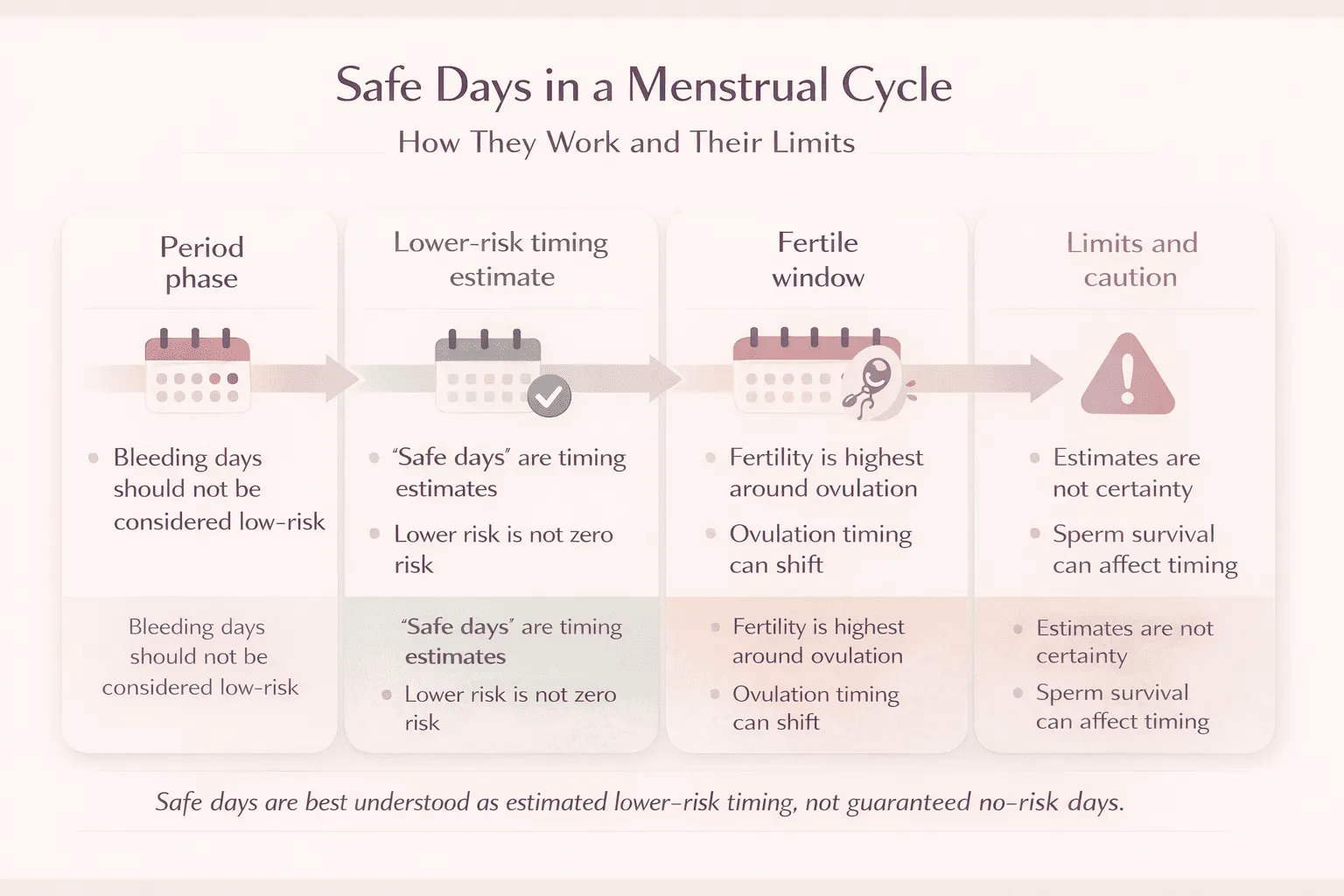
What people usually mean by “safe days”
When people talk about safe days, they usually mean days in the cycle when pregnancy is thought to be less likely because they seem farther away from ovulation. That idea comes from fertility awareness timing, where pregnancy risk is highest around the fertile window and lower outside it.
The important word here is less likely, not impossible. Safe days are timing-based estimates, and estimates become weaker when the cycle is less predictable.
Safe-day thinking is built around when ovulation is likely to happen in the cycle.
A lower-risk day is not the same thing as a guaranteed no-pregnancy day.
The idea works best when cycles are regular and carefully tracked, and even then it has limits.
“Safe days” means certain days are always completely risk-free.
Safe days are best understood as timing-based lower-risk estimates, not as a guarantee that pregnancy cannot happen.
How safe-day timing is usually estimated
Safe-day estimates usually start with the idea that fertility is highest around ovulation and lower farther away from it. In practical terms, that means the fertile window can move earlier or later depending on the cycle, rather than staying fixed on one calendar day every month.
Fertility-awareness timing methods are built around careful cycle tracking, but they still depend on estimates. That is why safe-day timing can be useful as guidance while still having clear limits in real life.
Want to estimate lower-risk timing more clearly?
Use your cycle information to estimate timing, while keeping the limits of calendar-based prediction in mind.
Why safe-day assumptions can fail
The biggest problem with safe-day assumptions is that real cycles do not always behave like a textbook calendar. Ovulation can shift, cycle length can vary, and the fertile window can overlap with days someone assumed were low risk.
Timing is also affected by the fact that sperm can survive for several days. That can push fertility-related timing earlier than many people expect and make calendar-based certainty feel stronger than it really is.
Why safe-day assumptions can break down
Why the days right after a period are not automatically safe
This is one of the most common misunderstandings. The days right after a period may feel “early” in the cycle, but that does not automatically make them risk-free. In shorter cycles, fertile timing can arrive sooner. If sperm survive long enough, those days can overlap more with fertility than people assume.
That is also why broad internet advice like “just after your period is always safe” can be misleading. The answer depends on your cycle pattern, not just the label of the day.
When safe-day estimates are less reliable
Safe-day estimates become less reliable when cycles are irregular, when dates are guessed from memory, or when recent months included stress, illness, travel, poor sleep, or other disruptions. These factors can shift the pattern enough that a calendar rule feels more certain than it really is.
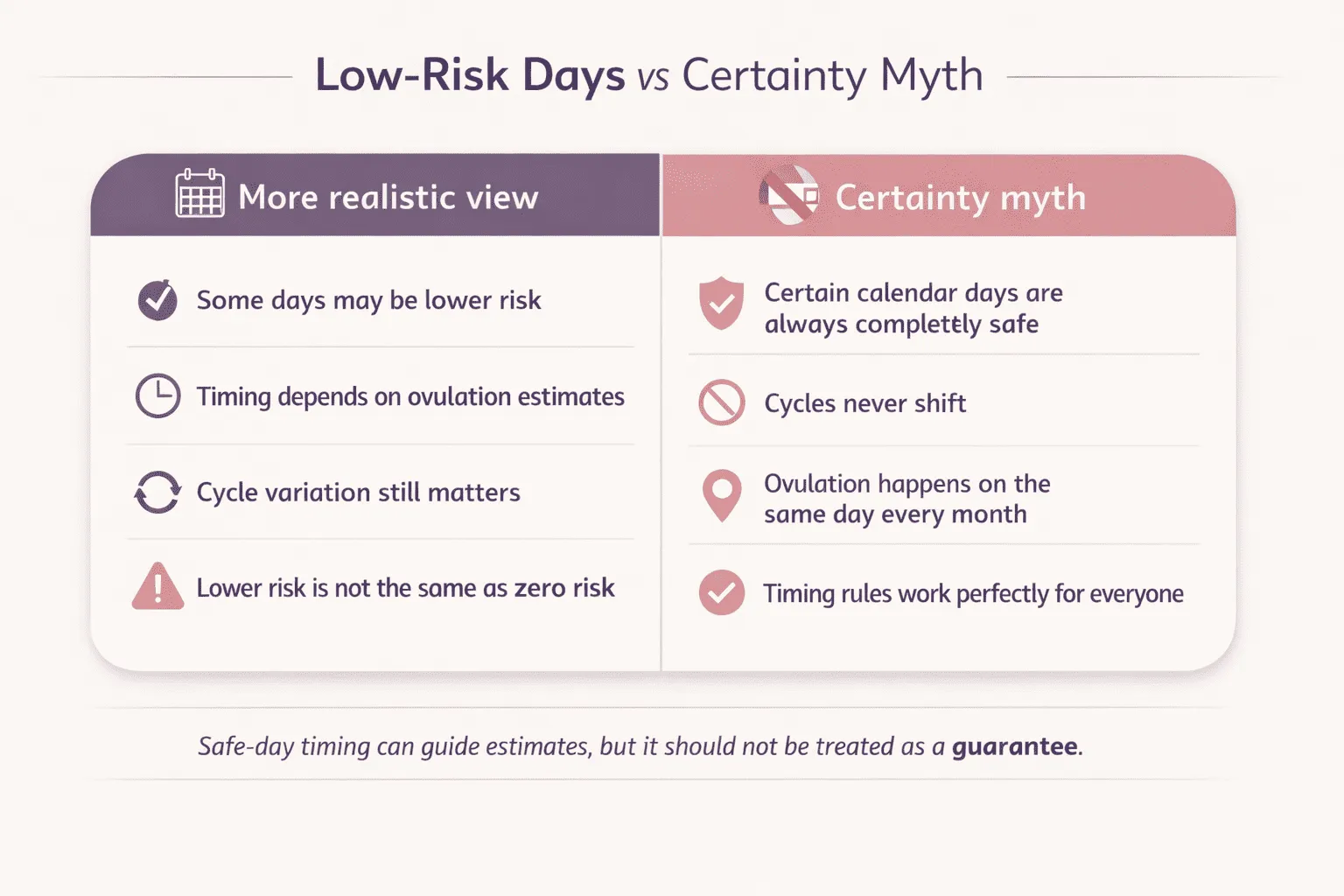
More realistic view
Some days may be lower risk based on timing estimates, but real cycles still have variation.
Less realistic myth
Certain calendar days are always completely safe for everyone in every cycle.
In simple terms, safe days can be thought of as estimated lower-risk timing, not as guaranteed no-risk timing.
How to use safe-day information more realistically
Think in probabilities
Lower risk is not the same thing as no risk.
Track carefully
Real cycle data is more useful than memory-based guessing.
Be extra cautious with irregular cycles
Irregular timing makes calendar-based assumptions less dependable.
Use calculators as guidance
A calculator can estimate timing, but it cannot directly confirm ovulation.
Safe-day timing is guidance, not certainty
The more irregular or disrupted the cycle is, the less dependable calendar-only assumptions become.
✦ Bottom line
Safe days can be useful as timing estimates, but they should never be treated as a promise. Real cycles vary, ovulation can shift, and pregnancy risk does not disappear just because a day looks “safe” on a calendar.
Estimate lower-risk timing more realistically with our Safe Days Calculator.
Helpful next steps
Explore the timing more clearly depending on whether you want a lower-risk estimate, a fertility-window view, or a deeper explanation of the limits.
Estimate lower-risk timing based on your cycle information.
See the timing that most influences pregnancy likelihood.
Get a clearer month-wide view of how period days, fertile timing, and ovulation estimates connect.
Frequently asked questions
These quick answers cover the questions people most often ask when trying to understand what “safe days” really means in a real-world cycle.
1What do people mean by safe days in a menstrual cycle?+
People usually mean days when pregnancy is thought to be less likely based on cycle timing. These estimates are often built around the idea that fertility is highest around ovulation and lower farther away from it.
2Are safe days completely safe?+
No. Safe days are not a guarantee. They are timing-based estimates, and real cycles do not always follow the same pattern every month.
3Why can safe-day assumptions fail?+
They can fail because ovulation timing can shift, cycle length can vary, and sperm can survive for several days. That means the fertile window can overlap with days people assumed were low risk.
4Do safe days work the same way for irregular cycles?+
No. Irregular cycles make timing harder to predict, which makes safe-day assumptions less reliable.
5Are the days right after a period always safe?+
Not always. In shorter or less predictable cycles, fertile timing can arrive earlier than expected, so the days just after a period are not automatically risk-free.
6Can a calculator help estimate lower-risk days?+
A Safe Days Calculator can help estimate timing, but it should be used as guidance rather than certainty. It cannot directly confirm ovulation or guarantee that pregnancy is impossible.
Editorial referencesSources and medical references
This guide is for educational use and should not replace personal medical advice.
+
Sources and medical references
This guide is for educational use and should not replace personal medical advice.
Safe-day timing can be useful as an estimate, but real cycles vary enough that it should not be treated like a promise.
Try a related tool
Start with the Period Calculator, browse the Tools Hub, or explore the Guides Hub.