Guide
Stages of the Menstrual Cycle Explained
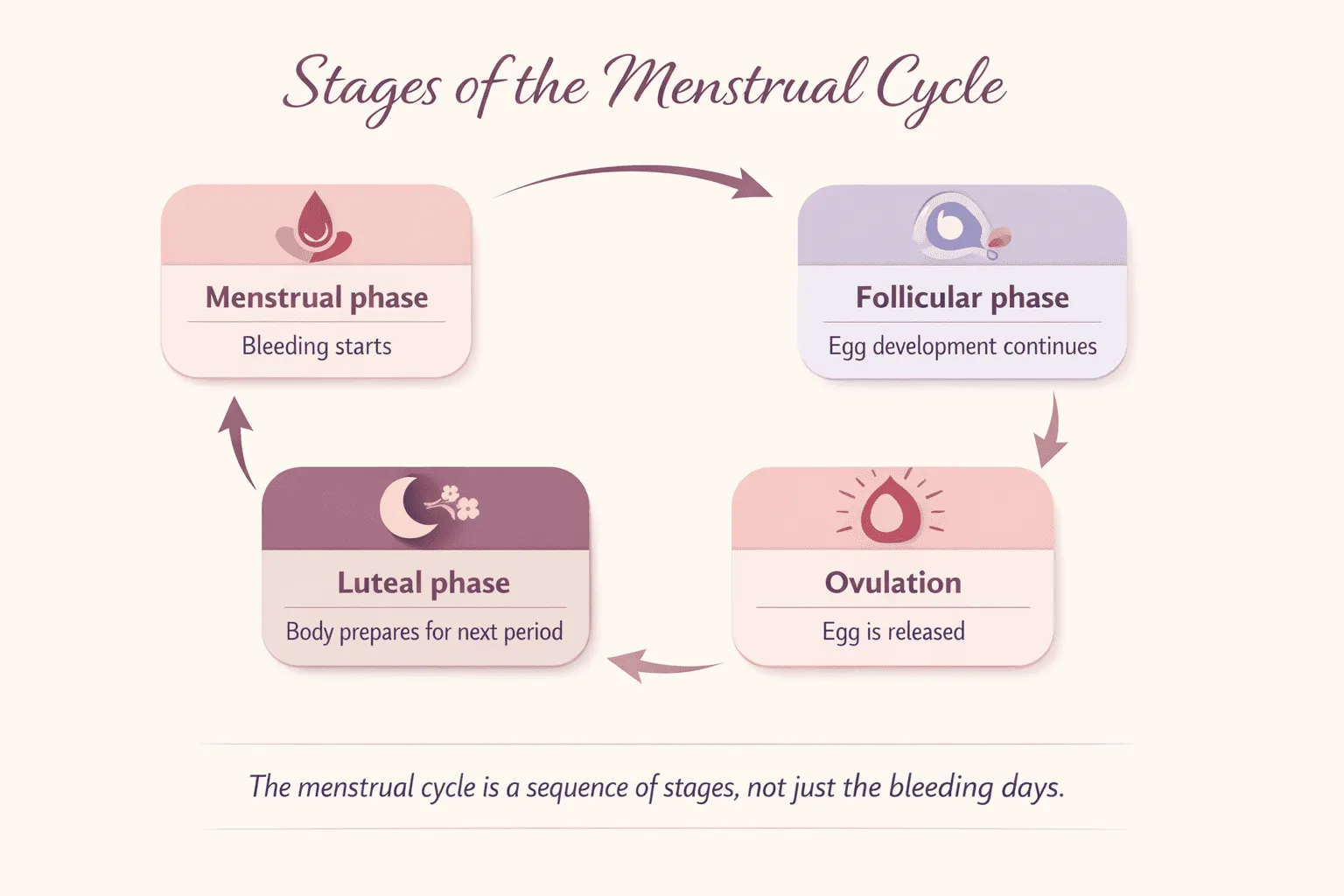
The menstrual cycle is not just one event. It is a sequence of stages that includes bleeding, egg development, ovulation, and the phase before the next period. Understanding these stages makes it much easier to understand period timing, fertile days, ovulation signs, and why symptoms can change across the month.
In this guide
⚡Quick Answer
- ✦The menstrual cycle is commonly explained in four stages: menstrual phase, follicular phase, ovulation, and luteal phase.
- ✦These stages help explain why bleeding, fertile days, ovulation signs, and pre-period symptoms happen at different times.
- ✦Not every stage has exactly the same length every month, which is one reason period dates can shift.
- ✦Understanding the stages makes tools like the Ovulation Calculator and Fertile Window Calculator much easier to understand.
Why understanding cycle stages matters
Many people think of the menstrual cycle only as the period itself, but bleeding is just one part of a bigger cycle. The body moves through different hormonal phases before, during, and after the period, and those phases help explain why energy, symptoms, discharge, ovulation timing, and fertile days can all change across the month.
Once you understand the cycle as a sequence of stages instead of one isolated event, it becomes easier to make sense of calculators, symptom patterns, and timing changes.
The period is important, but it is not the whole menstrual cycle.
Different stages are linked to different hormonal shifts across the cycle.
Ovulation and fertile timing happen in specific stages, not randomly anywhere in the month.
“The menstrual cycle just means the days you bleed.”
Bleeding is only one stage of a larger cycle that also includes egg development, ovulation, and the phase before the next period.
Stage 1: Menstrual phase
The menstrual phase is the stage when bleeding happens. This is the part most people simply call “the period.” It marks the start of a new cycle, which is why the first day of bleeding is usually counted as day 1.
During this stage, the uterine lining is shedding. For tracking purposes, this is the most important reference point because calculators and cycle-length measurements usually begin here.
Stage 2: Follicular phase
The follicular phase begins at the same time as the menstrual phase, but it continues beyond the days of bleeding. During this stage, follicles in the ovaries begin developing, and one of them will usually become dominant before ovulation.
This is also one of the stages that can vary more in length, which helps explain why total cycle length is not always the same every month.
A simple way to think about the early cycle
Stage 3: Ovulation
Ovulation is the stage when an egg is released. This stage is closely tied to the most fertile time in the cycle, which is why it matters so much for pregnancy timing and fertile-window estimates.
Ovulation is often talked about as if it always happens on day 14, but real cycles vary. That is why the timing of ovulation depends more on your actual cycle pattern than on one fixed day for everyone.
Want to understand where fertility fits inside the cycle?
Use cycle-based tools to see how ovulation and the fertile window fit into the larger menstrual cycle pattern.
Stage 4: Luteal phase
The luteal phase is the stage after ovulation and before the next period starts. This is often the stage when pre-period symptoms become more noticeable, such as bloating, breast tenderness, mood changes, fatigue, or cramping.
People often associate this stage with PMS, but the luteal phase is broader than PMS symptoms alone. It is a full cycle stage, not just a symptom label.
Earlier cycle
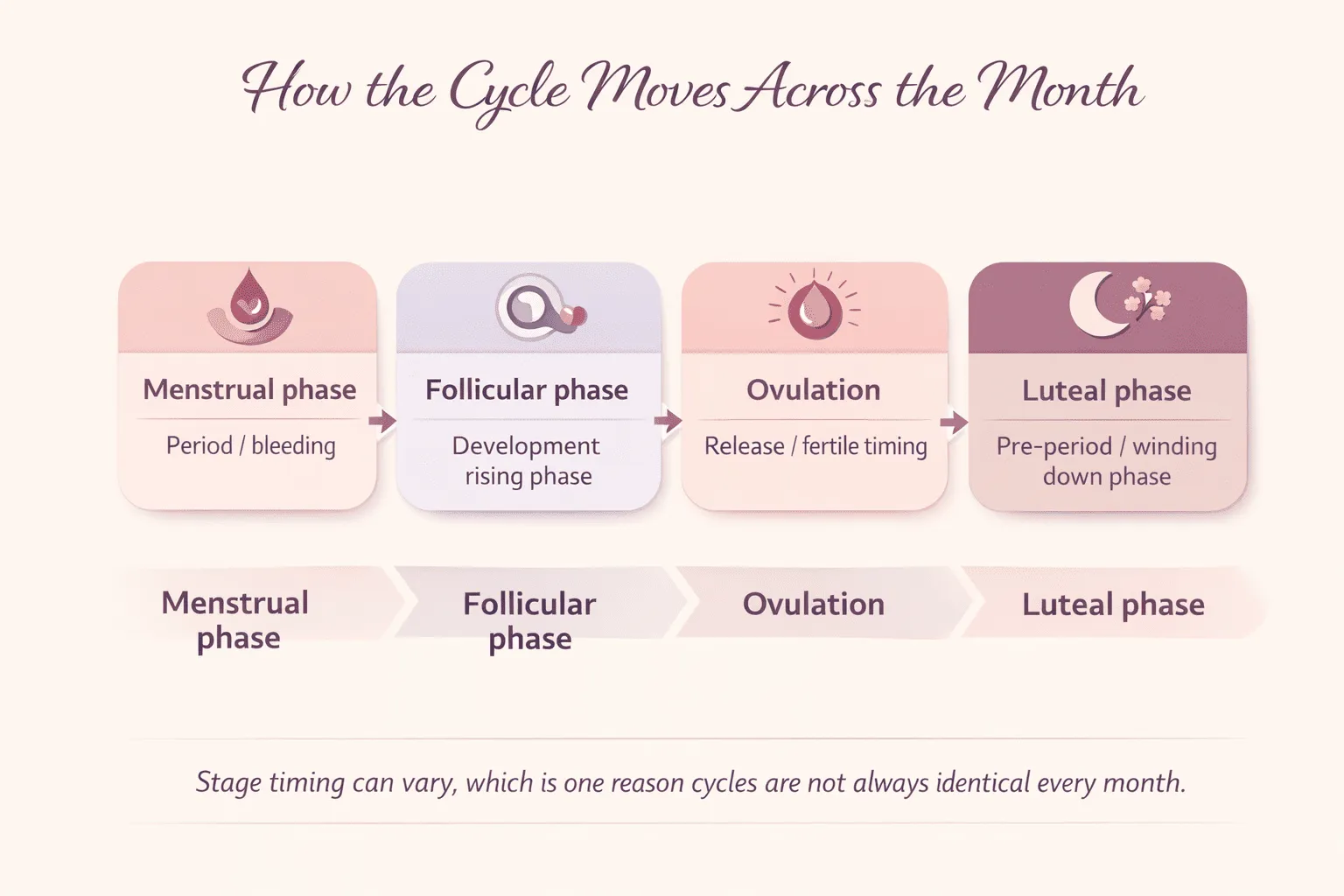
Bleeding starts, follicles develop, and the body moves toward ovulation.
Later cycle
Ovulation has happened, and the body moves through the luteal phase before the next period.
Why stage timing can vary from month to month
Not every stage has exactly the same length every cycle. This is one reason period dates can shift and why fertile timing is better understood as an estimate rather than a perfectly fixed calendar rule.
Stress, illness, sleep disruption, travel, exercise changes, and broader hormonal changes can all influence how the cycle unfolds. That does not always mean something is wrong — it often just means real cycles are more flexible than textbook diagrams suggest.
Track from day 1
The first day of the period is still the most useful anchor for understanding the cycle.
Look at patterns
Several months of tracking are more useful than trying to interpret one cycle in isolation.
Expect some variation
Real cycles are not always identical, even when they are still healthy.
Use the stages to interpret symptoms
Symptoms make more sense when you know which phase of the cycle you are likely in.
The menstrual cycle is a sequence, not one isolated event
Once you see the cycle as connected stages, it becomes easier to understand bleeding, fertile timing, ovulation signs, and pre-period symptoms.
✦ Bottom line
The menstrual cycle is made up of connected stages: menstrual phase, follicular phase, ovulation, and luteal phase. Understanding those stages helps you make better sense of period timing, fertile days, ovulation signs, and why symptoms shift across the month.
Explore the fertile part of the cycle more clearly with our Fertile Window Calculator.
Helpful next steps
Use the next step that fits whether you want to understand fertility timing, ovulation clues, or cycle basics more deeply.
Learn how fertility timing fits inside the ovulation stage.
See what signs may help you notice the ovulation stage more clearly.
See how cycle-stage knowledge connects with the real signs people often notice before a period begins.
Frequently asked questions
These quick answers cover the most common questions people have when trying to understand how the menstrual cycle is divided into stages.
1What are the main stages of the menstrual cycle?+
The menstrual cycle is commonly described in four main stages: the menstrual phase, follicular phase, ovulation, and luteal phase. Each stage reflects different hormonal changes and different events in the cycle.
2Does everyone move through the stages in exactly the same way?+
No. The overall pattern is similar, but cycle timing and symptoms can vary from person to person and even from month to month.
3Which stage is the most fertile?+
The most fertile timing is usually around ovulation and the days leading up to it. That is why the fertile window is closely linked to the ovulation stage.
4Is the luteal phase the same as PMS?+
Not exactly. The luteal phase is a full stage of the cycle after ovulation. PMS symptoms can happen during that stage, but the luteal phase is broader than PMS alone.
5Can the length of each stage vary?+
Yes. Some stages vary more than others, especially the follicular phase. That is one reason total cycle length can change from month to month.
6Why does understanding the stages matter?+
Understanding the stages helps explain why symptoms, bleeding, ovulation timing, fertile days, and period dates do not all happen at the same point in the cycle.
Editorial referencesSources and medical references
This guide is for educational use and should not replace personal medical advice.
+
Sources and medical references
This guide is for educational use and should not replace personal medical advice.
The menstrual cycle is most useful when understood as connected stages rather than a single bleeding event. That framing helps explain timing, symptoms, and fertility more clearly.
Try a related tool
Start with the Period Calculator, browse the Tools Hub, or explore the Guides Hub.