
Guide
Signs Your Period Is Coming
Many people notice a pattern of symptoms before their period starts, but those signs are not always identical every month. This guide explains common pre-period symptoms, how they can feel, why timing can vary, and how to tell the difference between your period likely coming soon and a cycle that may be later than usual.
In this guide
⚡Quick Answer
- ✦Common signs your period may be coming include cramping, bloating, breast tenderness, mood changes, acne, fatigue, and lower back discomfort.
- ✦These symptoms can be useful clues, but they do not always predict the exact day bleeding will start.
- ✦Symptoms may feel stronger some months, milder in others, or even show up a little earlier or later than usual.
- ✦A Late Period Calculator helps more than symptoms alone if your period feels later than expected.
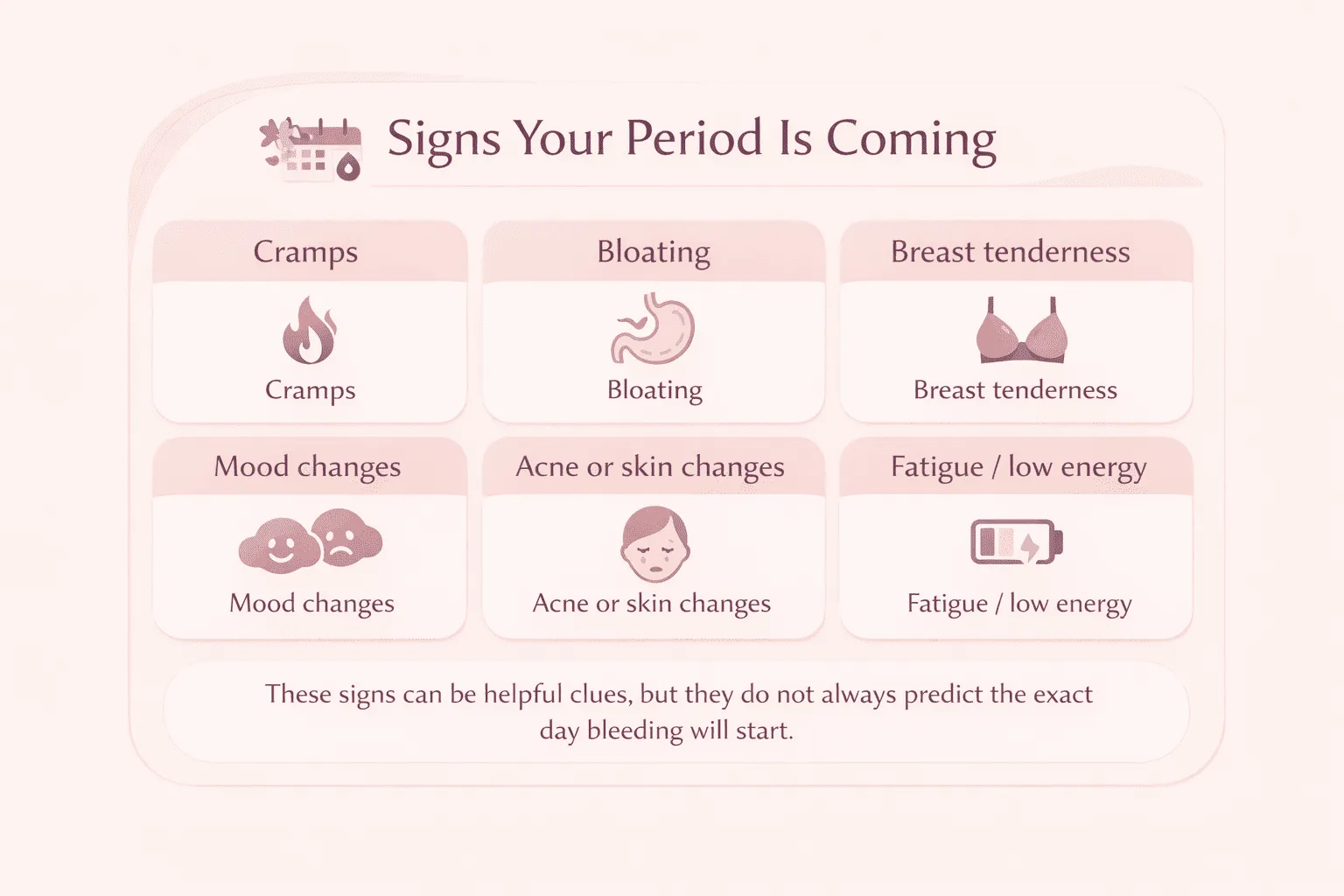
Common signs your period may be coming
Many people notice a familiar group of symptoms before their period starts. These can include mild cramping, bloating, breast tenderness, mood changes, lower back discomfort, acne flare-ups, fatigue, food cravings, or a general sense that the cycle is shifting into the pre-period phase.
Not everyone gets the same signs, and not every cycle feels identical. Some people have a strong, recognizable pattern. Others notice only one or two symptoms, or almost none at all.
Cramping, bloating, breast tenderness, acne, fatigue, and lower back discomfort are common pre-period changes.
Some people notice irritability, emotional sensitivity, or feeling more tired or mentally drained.
The most useful sign is often the overall pattern repeating in a familiar way across several cycles.
“If I feel period symptoms, bleeding will definitely start on the same day.”
Pre-period symptoms can be useful clues, but they do not always tell you the exact day your period will start.
Why symptoms can change from cycle to cycle
Period symptoms are influenced by hormonal changes, and those patterns are not always perfectly identical every month. Stress, sleep changes, illness, travel, exercise changes, and general routine disruption can all affect how symptoms feel and when they show up.
That means one month may feel very familiar, while another feels quieter or more intense. A change in symptom timing does not automatically mean something is wrong.
Symptoms can help — but they do not predict the exact day
One of the biggest mistakes people make is treating pre-period symptoms like a countdown timer. Symptoms can signal that your period may be approaching, but they are not a perfectly precise way to predict exactly when bleeding will start.
This is especially true if your cycle timing changes naturally from month to month or if you are already in a cycle that feels later than usual.
Want to compare symptoms with your actual cycle timing?
Use your real dates to see whether your period is likely just approaching or whether this cycle is later than usual for you.
Signs your period is coming vs a period that may be late
This is where many people get confused. Having familiar symptoms can make it feel like your period is about to start, but if bleeding is noticeably outside your usual timing range, symptoms alone may not settle the question.
The better approach is to compare your symptoms with your cycle history. If this still feels roughly within your normal timing, it may simply mean your period is approaching a little differently this month. If the cycle is clearly outside your usual pattern, the more useful question becomes whether the period is actually late rather than whether the symptoms “count.”
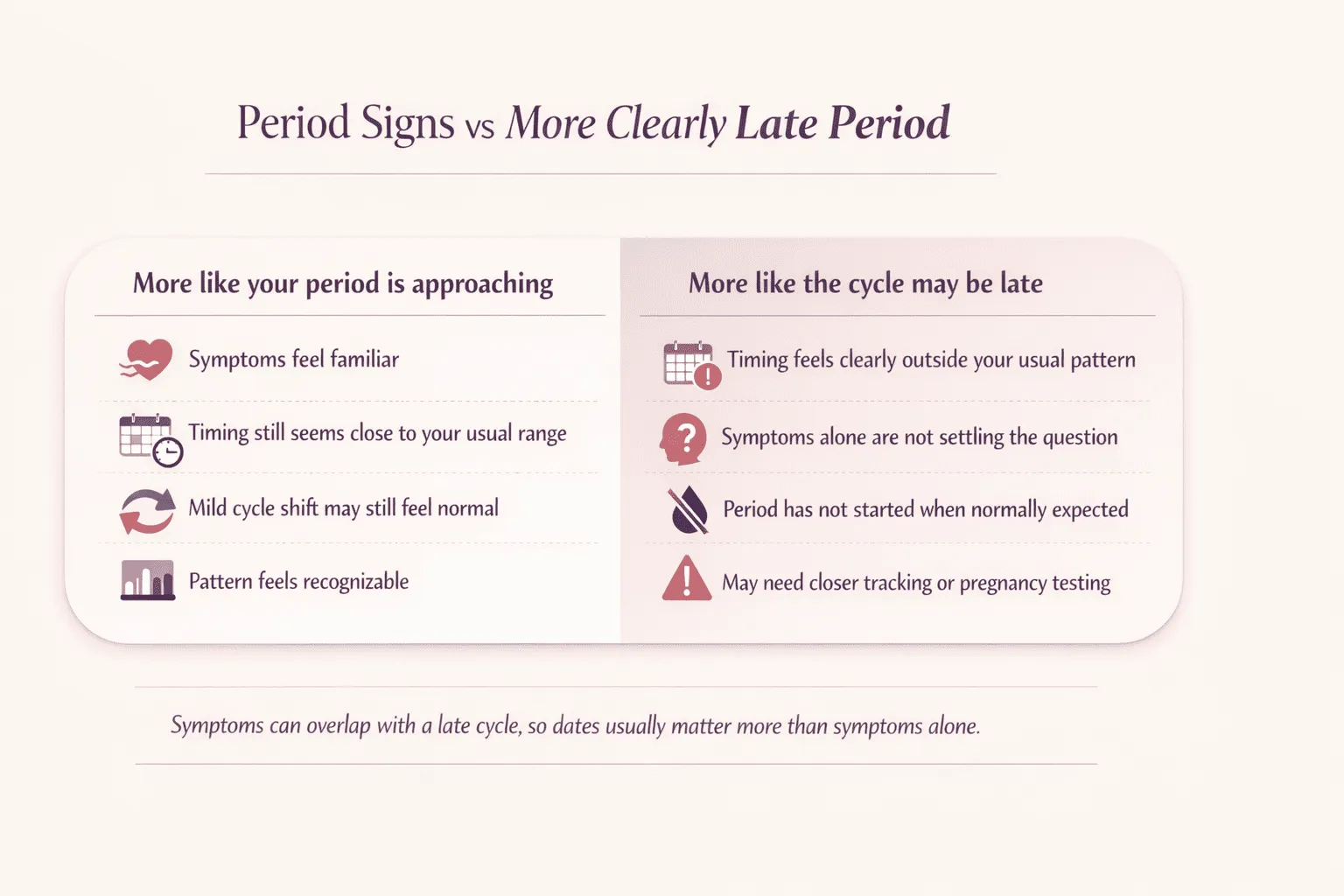
More like your period is approaching
Symptoms feel familiar and the timing still seems close to your usual range.
More like the cycle may be later than usual
Symptoms may be present, but the cycle timing feels clearly outside your normal pattern.
Period symptoms and pregnancy symptoms can overlap
This is another reason symptoms should be interpreted carefully. Breast tenderness, fatigue, bloating, and mood changes can happen before a period, but they can also overlap with early pregnancy symptoms.
That means symptoms alone are not a reliable way to tell the difference. If pregnancy is possible and your period is noticeably later than expected, comparing dates and considering a pregnancy test may be more useful than trying to decode symptoms alone.
How to understand your own pattern more clearly
Track your dates
The first day of each period is still the most important reference point.
Notice repeating symptoms
Patterns across several cycles are more useful than one month in isolation.
Use symptoms as clues
Symptoms can support awareness, but should not replace actual cycle timing.
Pay attention to major changes
Very different symptoms, much later timing, or repeated changes deserve a closer look.
Familiar symptoms are helpful — but your dates still matter more
Symptoms can support cycle awareness, but your actual period pattern is usually the better guide when timing feels uncertain.
✦ Bottom line
Signs your period is coming can be genuinely useful, but they are not a perfect countdown. The most helpful approach is to combine familiar symptoms with your real cycle timing rather than relying on symptoms alone.
Compare your symptoms with your real cycle timing using our Period Calculator.
Helpful next steps
Use the right next step depending on whether you want to compare your timing, check if this cycle is late, or understand why your dates may shift.
Compare today’s timing to your usual cycle and estimate when your period may start.
Use this when symptoms are present but the cycle feels clearly later than usual.
Helpful if you want the bigger cycle picture behind pre-period signs, timing changes, and fertile phases.
Frequently asked questions
These quick answers cover the most common questions people have when they feel period symptoms and want to know whether bleeding is likely to start soon.
1What are common signs your period is coming?+
Common signs can include cramping, bloating, breast tenderness, mood changes, acne flare-ups, lower back discomfort, fatigue, and changes in discharge. Not everyone gets the same symptoms, and they do not always happen in exactly the same way every cycle.
2How many days before a period do symptoms start?+
For many people, symptoms begin a few days before bleeding starts, but timing varies. Some notice changes earlier, while others only feel signs very close to the start of the period.
3Can period symptoms happen without the period starting right away?+
Yes. Some pre-period symptoms can start before bleeding begins, and timing may shift a little from cycle to cycle. Symptoms alone do not always tell you the exact day your period will start.
4Can period symptoms feel like pregnancy symptoms?+
Sometimes yes. Symptoms like breast tenderness, fatigue, bloating, and mood changes can overlap, which is why symptoms alone are not a reliable way to confirm pregnancy or rule it out.
5Does having symptoms mean my period is definitely coming?+
Not always. Symptoms can be helpful clues, but they are not a perfect guarantee of when bleeding will start. If your period is much later than usual, it is better to compare with your normal cycle pattern instead of relying on symptoms alone.
6When should I pay more attention to period symptoms?+
It is worth paying more attention if symptoms become much more severe than usual, feel very different from your normal pattern, or happen along with major cycle changes such as repeated late periods, missed periods, very heavy bleeding, dizziness, or severe pain.
Editorial referencesSources and medical references
This guide is for educational use and should not replace personal medical advice.
+
Sources and medical references
This guide is for educational use and should not replace personal medical advice.
Period symptoms can be helpful clues, but they should be interpreted in the context of your actual cycle timing rather than used as exact proof of when bleeding will start.
Try a related tool
Start with the Period Calculator, browse the Tools Hub, or explore the Guides Hub.