
Guide
Ovulation Signs and Symptoms
Ovulation signs can help you understand your cycle better, especially if you are trying to conceive or track fertile timing more closely. But signs are not all equally reliable. This guide explains the most common body changes people notice around ovulation and how to use them realistically.
In this guide
⚡Quick Answer
- ✦Common ovulation signs can include clear slippery cervical mucus, mild mid-cycle discomfort, and a slight temperature rise after ovulation.
- ✦These signs can support timing awareness, but they do not all prove ovulation on their own.
- ✦Some people notice obvious changes, while others notice very little.
- ✦An Ovulation Calculator or Fertile Window Calculator can help turn tracking into a more practical estimate.
Why ovulation signs matter
Ovulation signs matter because they can help you understand when your cycle is moving into a more fertile phase. For people trying to conceive, that can help with timing. For people who simply want better cycle awareness, it can make the month feel easier to interpret.
The key is to use signs as clues, not as perfect proof. Some signs happen before ovulation, some around it, and some are easier to spot only after the fact.
Signs can be useful, but one symptom alone is rarely enough to prove exact ovulation timing.
Some people notice clear changes, while others have much subtler patterns.
Signs are usually more useful when combined with cycle tracking and timing tools.
“One ovulation symptom always proves exact ovulation timing.”
Ovulation signs are useful clues, but they work best as supportive evidence rather than exact proof by themselves.
Common ovulation signs people notice
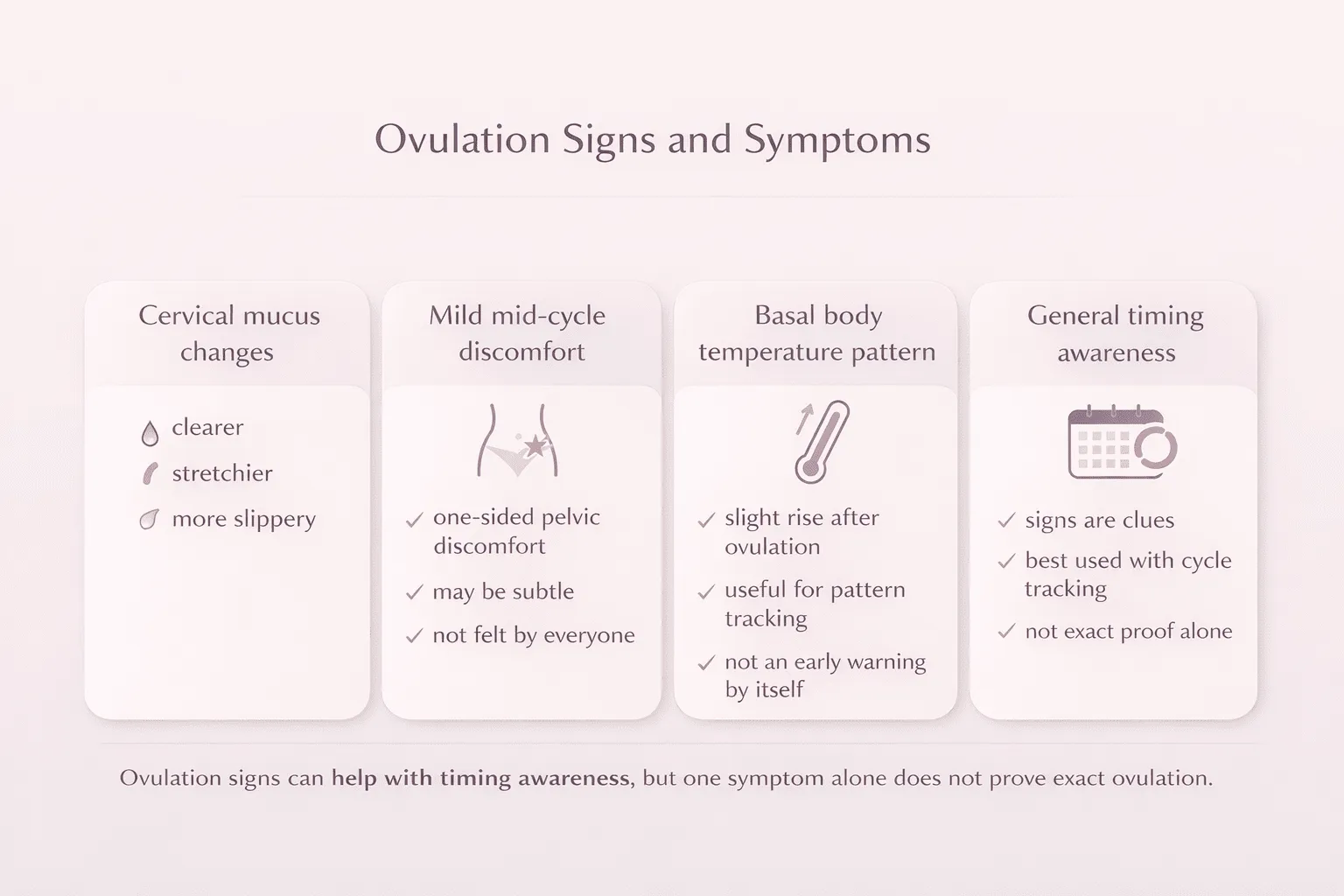
One of the most widely discussed signs is a change in cervical mucus. Around ovulation, many people notice discharge becoming clearer, stretchier, thinner, and more slippery. This can be a helpful sign that fertility is approaching.
Some people also notice one-sided lower abdominal discomfort around the middle of the cycle. This is often called mittelschmerz. This can happen around the middle of the cycle and may feel different from month to month.
Another commonly tracked sign is basal body temperature. Basal temperature usually rises slightly after ovulation, which makes it useful for seeing a pattern over time rather than for predicting ovulation far in advance.
Signs people often track
What these signs can and cannot tell you
Ovulation signs can help you understand timing better, but they are not all equally strong. Some point toward approaching fertility, while others mainly help you recognize that ovulation may already have happened.
That is why using signs in isolation can be limiting. A single symptom can be missed, misread, or absent in one cycle and obvious in another.
Why cervical mucus is one of the most useful signs
Cervical mucus often changes in a way people can observe directly. When it becomes clearer, more slippery, and more stretchy, that can signal more fertile timing. Among natural signs, this is one of the most practical for many people because it can appear before ovulation rather than only after it.
That does not mean the mucus change tells you the exact moment ovulation happens. It means your body may be moving into a more fertile phase.
Why temperature is helpful, but different
Basal body temperature tracking is useful for spotting a pattern over time because the temperature rise tends to happen after ovulation. That makes it valuable for learning your cycle, but less useful as a same-day warning signal if your main goal is perfect forward prediction.
Want to turn these signs into a more practical timing estimate?
Use cycle history together with body signs instead of relying on one symptom alone.
More realistic view
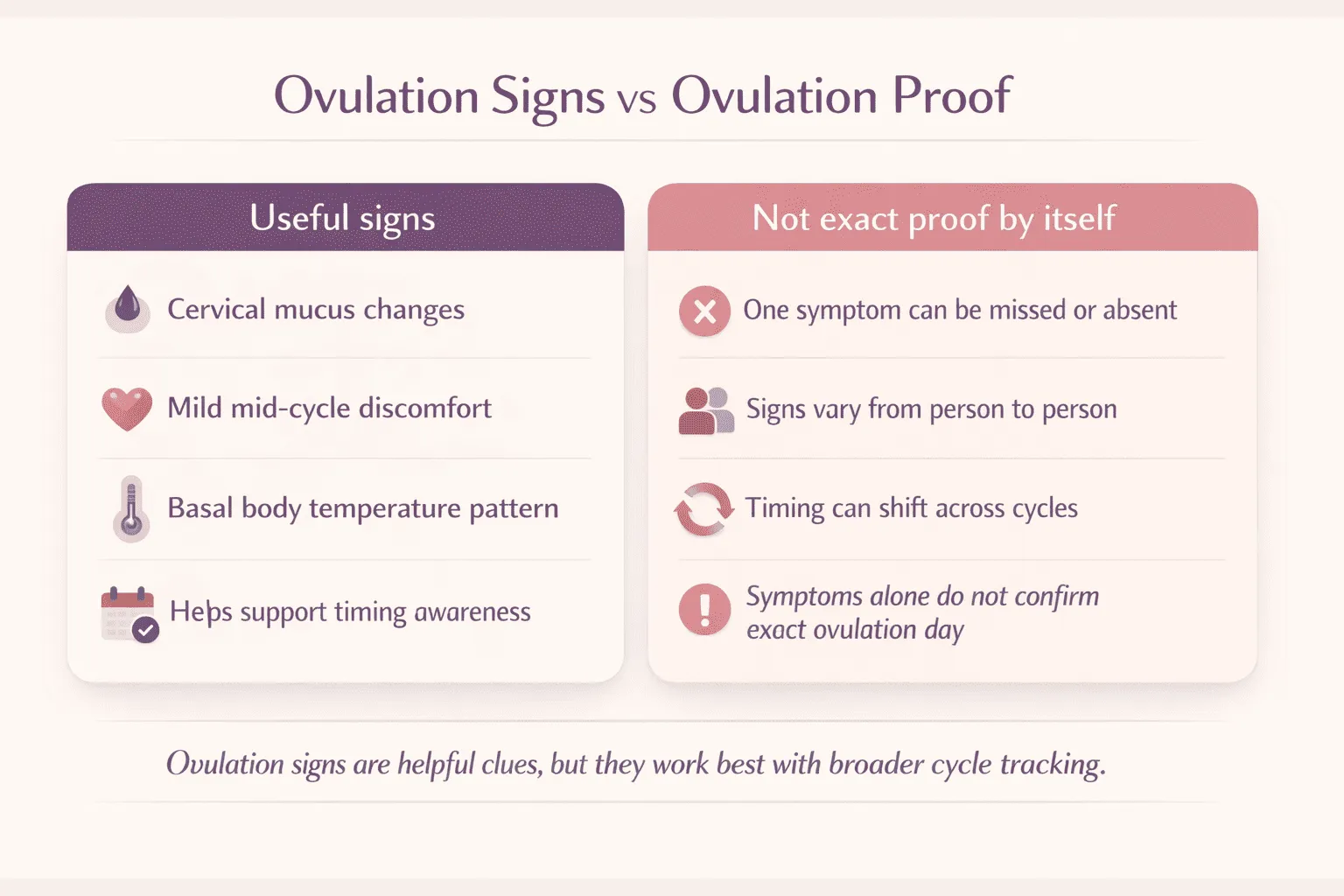
Ovulation signs are useful clues that support timing awareness and cycle tracking.
Less realistic assumption
One symptom always proves exact ovulation timing with certainty in every cycle.
In simple terms, ovulation signs are most useful when they help you narrow timing and spot patterns — not when they are treated like guaranteed proof by themselves.
How to use ovulation signs in a practical way
Track more than one sign
Combining mucus, timing, and cycle history is usually more helpful than relying on one clue.
Look for patterns over time
Repeated monthly patterns are more useful than a single observation in one cycle.
Use tools for estimation
Calculators help turn cycle data into a more practical fertile-timing estimate.
Expect variation between cycles
Not every cycle produces identical symptoms, and some cycles feel much quieter than others.
What if you do not notice any strong signs?
That is normal too. Not everyone notices obvious ovulation symptoms. A lack of noticeable signs does not automatically mean something is wrong. It may simply mean your body’s signals are subtle or that tracking methods based on observation are less obvious for you.
No obvious sign does not automatically mean no ovulation
Some cycles are simply quieter and harder to read. That is why pattern tracking over time is usually more useful than judging one month alone.
✦ Bottom line
Ovulation signs and symptoms can be genuinely helpful for cycle awareness, but they work best as clues rather than exact proof. The smartest approach is to combine body signs with cycle tracking and timing tools instead of relying on one symptom alone.
Turn signs into a more practical estimate with our Ovulation Calculator.
Helpful next steps
Use the right next step depending on whether you want an ovulation-focused estimate, a broader fertile-range view, or a deeper guide on timing.
Estimate likely ovulation timing from your cycle history.
Estimate the broader fertile range around ovulation.
See where ovulation fits into the wider cycle instead of looking at body signs in isolation.
Frequently asked questions
These quick answers cover the most common questions people have when trying to interpret possible ovulation signs more realistically.
1What are the most common ovulation signs?+
Common signs people look for include clearer and more slippery cervical mucus, mild changes in pelvic sensation, a slight rise in basal body temperature after ovulation, and changes in cycle timing that suggest the fertile window is approaching.
2Can ovulation symptoms prove that ovulation happened?+
Not by themselves. Symptoms can be useful clues, but they do not confirm ovulation with certainty. They are better used as supportive signs alongside cycle tracking or other methods.
3What does ovulation discharge usually look like?+
Many people notice cervical mucus becoming clearer, stretchier, thinner, and more slippery around ovulation. It is often compared to raw egg white because that texture can help sperm move more easily.
4Does everyone feel ovulation pain?+
No. Some people notice one-sided mid-cycle discomfort, while others feel nothing noticeable at all. Not feeling pain does not mean ovulation did not happen.
5When does basal body temperature change?+
Basal body temperature usually rises slightly after ovulation. That means it can help you notice a pattern over time, but it is not a warning sign that ovulation is about to happen in advance.
6Are ovulation signs useful if my cycle is irregular?+
They can still be helpful, but irregular cycles make timing less predictable. In that situation, signs are often best used as extra context rather than as a precise fertility forecast.
Editorial referencesSources and medical references
This guide is for educational use and should not replace personal medical advice.
+
Sources and medical references
This guide is for educational use and should not replace personal medical advice.
Ovulation signs can help you track patterns and timing more intelligently, but they work best as supportive clues rather than as stand-alone proof.
Try a related tool
Start with the Period Calculator, browse the Tools Hub, or explore the Guides Hub.