
Guide
Why Is My Period Late? Causes, Timing, and When It’s Considered Late
A period is usually considered late when it has moved past your expected timing based on your normal cycle pattern. This guide explains common reasons it happens, when timing shifts may still be normal, and when to test, wait, or get medical advice.
In this guide
⚡Quick Answer
- ✦A period is usually called late when it has not started around the time you would normally expect based on your usual cycle pattern.
- ✦Common reasons include stress, illness, travel, sleep disruption, weight change, hormonal shifts, breastfeeding, some medications, and pregnancy.
- ✦One late period does not always mean something is wrong, but repeated changes or missing periods deserve more attention.
- ✦A Late Period Calculator can help compare today’s timing to your usual cycle, but it cannot diagnose the cause.
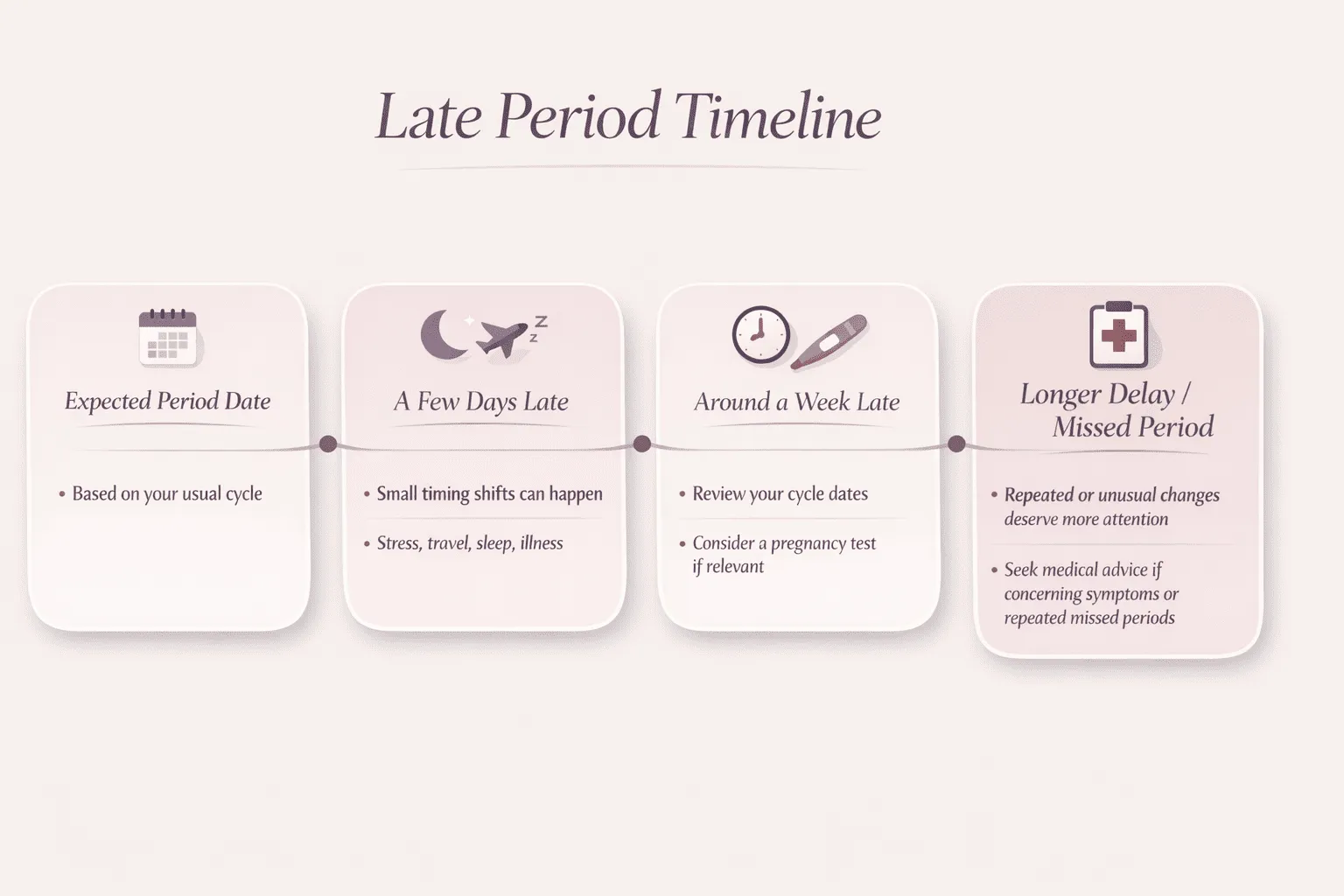
What counts as a late period?
There is no single number that fits everyone. A period is usually considered late when it has not started around the time you normally expect based on your own pattern. If your cycle is usually regular, even a short delay can feel unusual. If your cycles naturally vary from month to month, the more useful question is whether this cycle is outside your usual range rather than whether it is late by an exact number of days.
This is why it helps to know your personal baseline. If you do not already track it, start noting the first day of each period, your approximate cycle length, and anything major that happened that month such as travel, illness, stress, disrupted sleep, or a change in exercise or eating patterns. That makes it easier to see whether timing changes are a one-off shift or part of a larger pattern.
A short delay can happen even in otherwise healthy cycles and does not always point to a problem.
A bigger concern is when the timing is clearly outside what is normal for you or keeps happening repeatedly.
If a period does not come for a much longer stretch or cycles stop altogether, that deserves more careful follow-up.
“A late period always means pregnancy or something serious.”
Pregnancy is one possible reason, but late periods can also happen because of stress, illness, travel, sleep disruption, weight change, exercise changes, hormonal shifts, and other temporary factors.
Common reasons your period may be late
A late period is a timing change, not a diagnosis. Many different factors can shift when bleeding starts. Some are temporary. Some point to an underlying hormonal pattern. The most useful way to think about causes is by grouping them into everyday disruptions, reproductive timing, and medical or hormone-related factors.
Common temporary causes
- Stress or emotional strain
- Travel and routine disruption
- Illness or recovery after being sick
- Sleep changes or poor sleep
- Sudden weight change
- Very intense exercise or under-fueling
Other possible reasons
- Pregnancy
- Breastfeeding
- Starting, stopping, or changing contraception
- Hormonal conditions such as PCOS
- Perimenopause timing changes
- Thyroid or other endocrine issues
Pregnancy is one possible reason, but not the only one
When a period is late, pregnancy is one possible explanation. But it is not the only one, and assuming pregnancy too early can create unnecessary panic. At the same time, ignoring the possibility can delay a practical next step. The better approach is to combine timing with context: whether pregnancy is possible, whether your cycle is usually regular, and whether anything changed this month.
If pregnancy is possible and your expected date has passed, using a home pregnancy test may be reasonable depending on your timing. If pregnancy is not likely, it may still help to compare this cycle against your usual pattern using a Late Period Calculator or your period log before jumping to conclusions.
Want to compare today’s timing to your usual cycle?
Use your real cycle history to see whether this delay looks mild, more clearly late, or part of a broader irregular pattern.
Late, irregular, and missed are not the same thing
These words are often used interchangeably, but they are not identical:
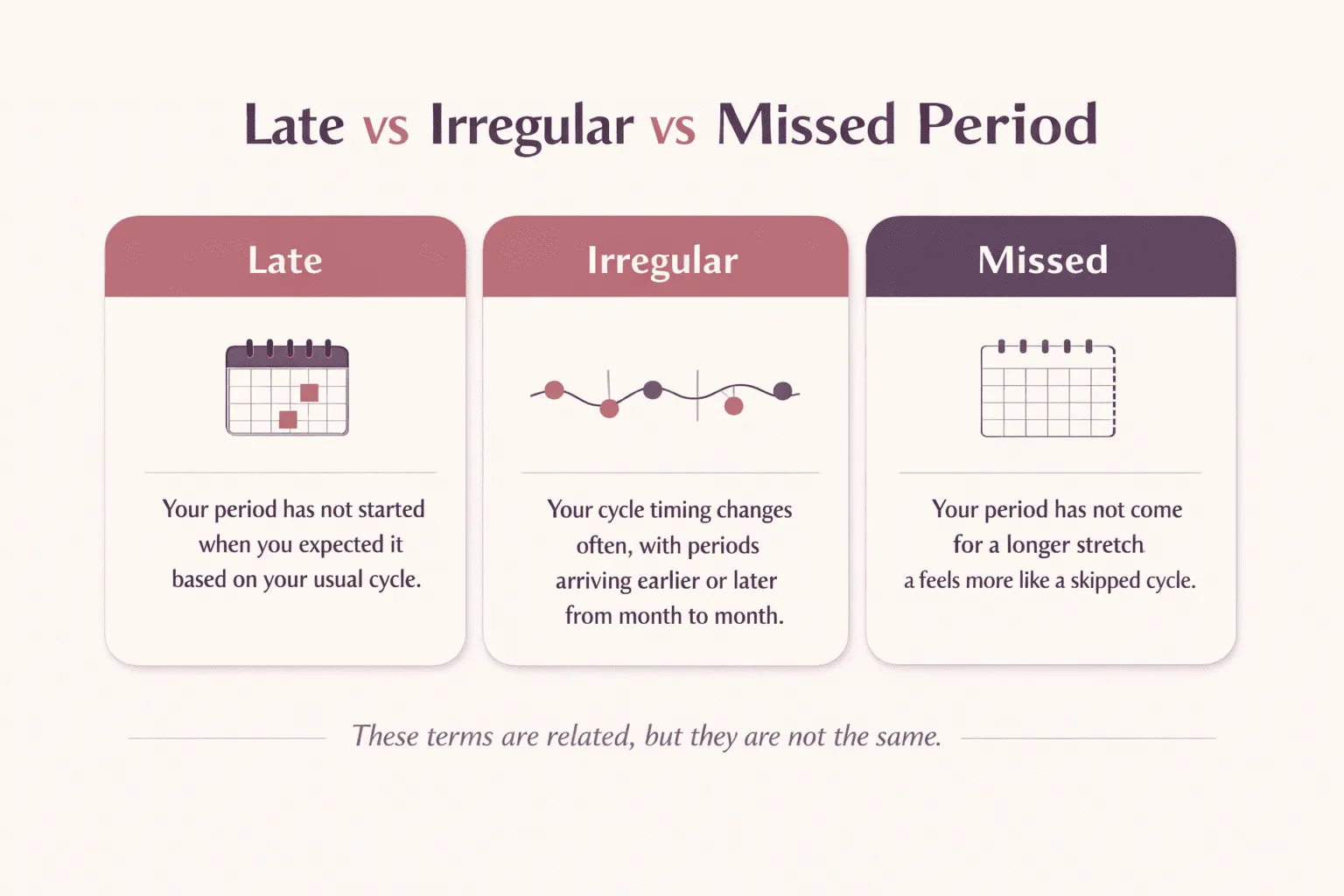
In simple terms, a late period means this cycle has not arrived when you expected, irregular periods describe a pattern that changes often, and a missed period usually feels more like a skipped cycle than a short delay.
This distinction matters because the next step is different. A one-time late period may be watched. Repeated irregularity may point toward a pattern worth tracking more closely. A missed period may call for pregnancy testing or medical advice sooner, depending on the situation.
What to do when your period is late
Check your dates
Look at the first day of your last period and your typical cycle length. Many people realize they were using a rough guess rather than an actual date.
Review this month
Think about stress, travel, illness, sleep, major exercise changes, medication changes, breastfeeding, or weight changes.
Consider pregnancy testing
If pregnancy is possible, a test may be the most practical next step rather than guessing from symptoms alone.
Track the pattern
If this keeps happening, start tracking cycle dates consistently. Repeated changes matter more than one unusual month.
When to get medical advice
A one-off timing change is not always urgent, but some situations deserve more attention. Consider medical advice if periods keep arriving much later than usual, if they stop for a longer stretch, if your pattern changes sharply without a clear reason, or if late periods come with symptoms such as severe pain, heavy bleeding, dizziness, fainting, or other symptoms that feel out of the ordinary for you.
It is also reasonable to seek advice if you think there may be an underlying pattern such as repeated irregular cycles, symptoms suggestive of a hormonal issue, or uncertainty about how to interpret ongoing timing changes.
Get help sooner if symptoms feel concerning
Severe pain, very heavy bleeding, fainting, dizziness, or long stretches without a period are good reasons not to rely only on guesswork.
✦ Bottom line
A late period is a timing change, not a diagnosis. Pregnancy is one possible reason, but stress, illness, travel, sleep disruption, weight change, and hormonal shifts can also delay a cycle. What matters most is how this month compares with your usual pattern and whether the change keeps repeating.
Compare today’s timing with your usual cycle using our Late Period Calculator.
Helpful next steps
Choose the best next step depending on whether this feels like a one-time delay, a broader pattern, or a stress-related shift.
Compare this cycle with your usual timing and see whether today is outside your normal range.
Better suited for cycles that do not follow a predictable rhythm every month.
Useful when you are trying to tell whether this feels like a true delay or just a pre-period phase.
Frequently asked questions
These quick answers cover the questions people most often have when a period is later than expected, including stress, pregnancy possibility, timing changes, and when to get medical advice.
1How many days late can a period be before it is considered late?+
There is no single number that fits everyone. A period is usually considered late when it has not started around the time you would normally expect based on your own cycle pattern. If your cycles are very regular, even a short delay can feel late. If your cycles vary naturally, it is more helpful to compare this month with your usual range.
2Can stress make your period late?+
Yes. Stress can affect hormones involved in ovulation and cycle timing, which may delay a period for some people. But stress is not the only explanation, so it should not automatically be assumed to be the reason every time a period is late.
3Can you be pregnant if your period is late?+
Yes. Pregnancy is one possible reason for a late or missed period. If pregnancy is possible and your period has not arrived when expected, taking a home pregnancy test is often a practical next step.
4Is a one-time late period always a sign of a problem?+
Not always. A one-off delay can happen because of stress, travel, illness, sleep disruption, weight change, intense exercise, breastfeeding, or other temporary factors. Repeated delays, missed periods, or major changes in your usual cycle pattern deserve more attention.
5When should I speak to a doctor about a late period?+
Consider medical advice if your periods stop for several months, if late or missed periods keep happening, or if the change comes with severe pain, very heavy bleeding, dizziness, fainting, or other unusual symptoms.
6What is the difference between a late period and irregular periods?+
A late period means this cycle has not started when you expected it. Irregular periods describe a pattern that changes often over time, such as cycles arriving much earlier or later from month to month.
Editorial referencesSources and medical references
This guide is for educational use and should not replace personal medical advice.
+
Sources and medical references
This guide is for educational use and should not replace personal medical advice.
These references support general educational guidance about late or missed periods, menstrual-cycle timing, and when it may make sense to seek medical advice.
Try a related tool
Start with the Period Calculator, browse the Tools Hub, or explore the Guides Hub.