
Guide
How to Use a Period Calculator With Irregular Cycles
A period calculator can still help when your cycles are irregular, but the output should be treated as a timing range rather than one exact next date. This guide explains how to use the tool more realistically when your cycle length changes from month to month.
In this guide
⚡Quick Answer
- ✦Yes, you can still use a period calculator with irregular cycles, but the result should be treated as an estimate, not a guaranteed date.
- ✦The calculator is most useful when you use it to understand timing ranges, patterns, and cycle variation over time.
- ✦The more accurate your tracking history is, the more helpful the estimate becomes.
- ✦An Irregular Period Calculator helps more than a simple date guess when your cycle changes often.
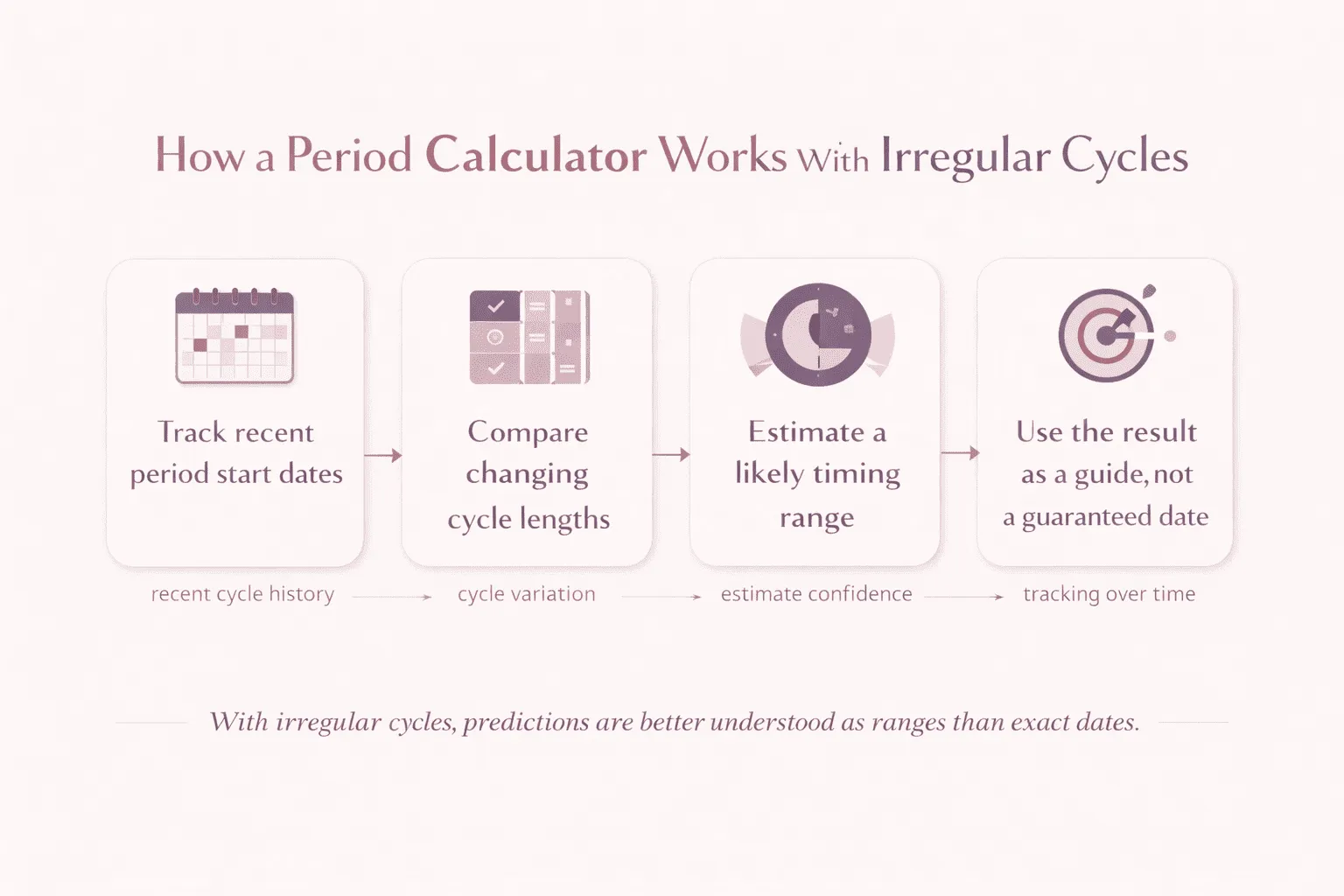
What changes when your cycles are irregular
A period calculator works best when your cycle follows a fairly stable pattern. When your cycles are irregular, the calculator has less consistency to work with, which means the prediction becomes less about one exact next date and more about a likely range.
That does not make the tool useless. It simply changes how you should use it. Instead of expecting certainty, use it to understand whether your cycle variation looks mild, moderate, or highly unpredictable over time.
Predictions are usually closer to an expected date when timing changes very little.
Predictions are better understood as estimates because cycle length shifts more often.
The real value is seeing trends across several months, not relying on one prediction.
“If the calculator gives me a date, my period should definitely come that day.”
With irregular cycles, calculator results are better treated as timing guidance and pattern support, not exact-day promises.
What information gives a more useful estimate
The calculator becomes more useful when the information you enter is accurate and based on real tracking, not memory alone. The most important detail is the first day of each recent period. If you only remember rough timing, the prediction becomes less reliable from the start.
If you know your shortest and longest recent cycle lengths, that can also help you think in ranges rather than averages. For irregular cycles, a range often reflects reality better than one neat number.
Most helpful things to track
Want an estimate built for less predictable cycle timing?
Use recent start dates and think in timing ranges, not one fixed promise date.
Do not expect an exact next date every time
This is one of the biggest mistakes people make with irregular cycles. A calculator may still show a likely next period date, but that does not mean your body will follow it exactly. If your cycle varies a lot, the most realistic mindset is: use the date as a guide, not a promise.
This matters even more if your recent months have included stress, poor sleep, illness, travel, medication changes, breastfeeding, or weight change. All of those can make the next estimate less predictable.
Range-based thinking is better than average-only thinking
If your cycles are irregular, using one average cycle length can be helpful as a rough starting point, but it can also hide how much your timing really shifts. For example, if your cycle sometimes comes much earlier and sometimes much later, one average may look neat on paper while still being a poor reflection of what actually happens.
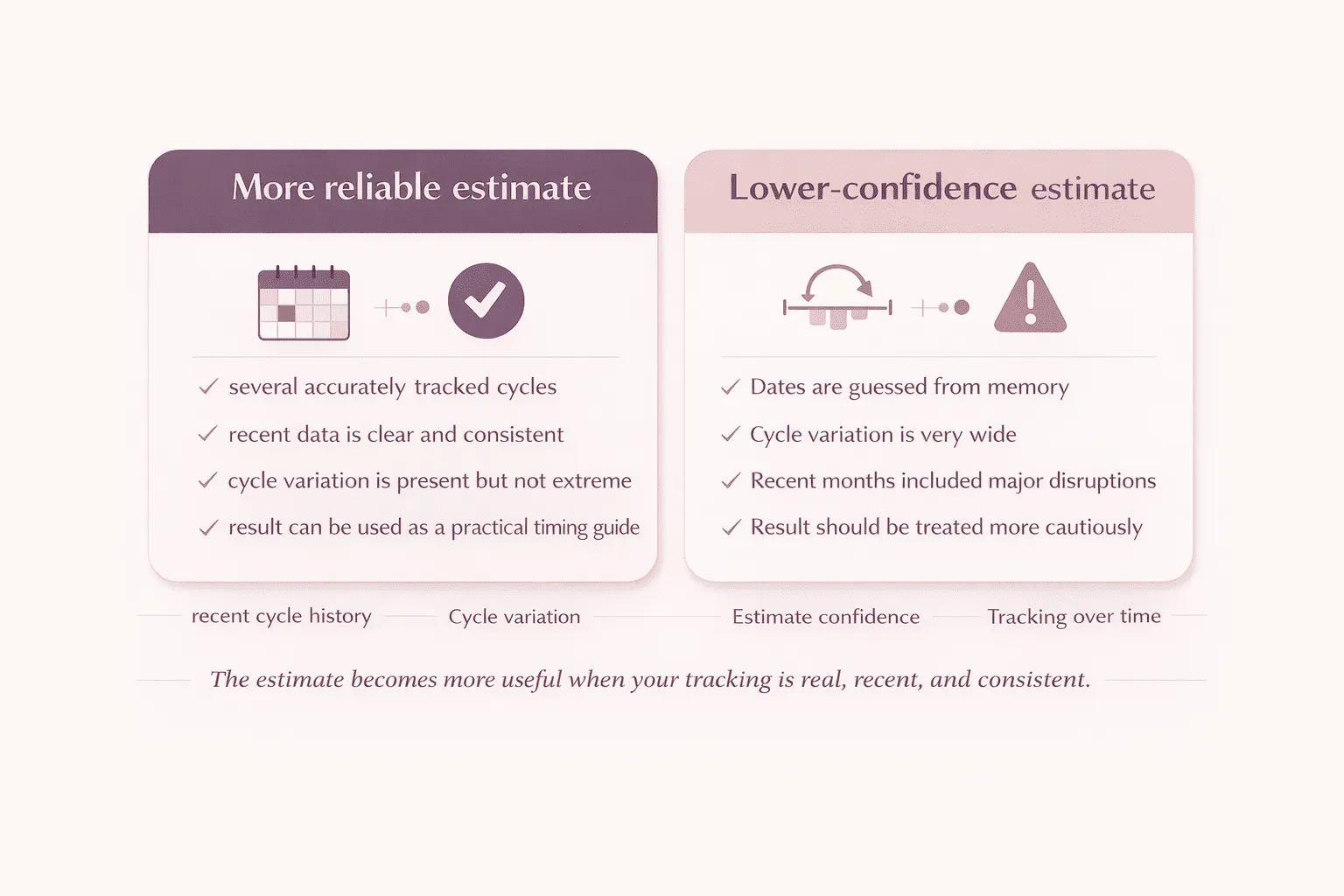
More reliable estimate
You have several accurately tracked cycles, and the variation is present but not extreme.
Lower-confidence estimate
You are guessing dates from memory, have very wide cycle variation, or several recent months included major disruptions.
In simple terms, the calculator becomes more useful when your inputs are real, recent, and consistent. It becomes less useful when the cycle pattern is highly unpredictable or the starting data is vague.
How to use the result in a realistic way
Treat it as a range
Think in terms of likely timing rather than one guaranteed day.
Keep updating it
Fresh cycle data usually gives more useful estimates than old assumptions.
Use it with tracking notes
Add context like stress, illness, travel, and routine changes so the numbers make more sense later.
Escalate if unpredictability keeps building
A calculator can support tracking, but it cannot replace medical evaluation when irregularity keeps getting worse or feels concerning.
When a calculator is not enough on its own
A period calculator is a useful support tool, but it is not designed to explain why your cycle is irregular. If periods keep becoming harder to predict, stop for a long stretch, or irregular timing comes with severe pain, very heavy bleeding, dizziness, fainting, or other unusual symptoms, it is better not to rely on the calculator alone.
A calculator supports tracking — it does not diagnose the cause
The tool is best for pattern awareness and timing support. It should not replace proper evaluation when irregularity becomes persistent or concerning.
✦ Bottom line
A period calculator can still be genuinely useful with irregular cycles, but only if you use it the right way. Think in ranges, use real tracking data, and treat the result as a pattern guide rather than an exact-day guarantee.
Track less predictable timing more realistically with our Irregular Period Calculator.
Helpful next steps
Choose the right next step depending on whether you want a better irregular-cycle estimate, a broader cause guide, or stronger tracking inputs.
Use a tool designed for less predictable cycle timing.
Understand the broader reasons your cycle may be hard to predict.
Improve the data you enter so your estimates become more useful over time.
Frequently asked questions
These quick answers cover the most common questions people have when using a period calculator with less predictable cycle timing.
1Can a period calculator work if my cycles are irregular?+
Yes, but it should be treated as an estimate rather than a precise prediction. A calculator can still help you compare patterns, spot timing ranges, and keep track of cycle changes over time, even when the exact next date is harder to predict.
2Why are period predictions less accurate with irregular cycles?+
Predictions depend on cycle patterns. When your cycle length changes often, the calculator has less consistency to work with, so the result becomes more of a range or estimate than a fixed date.
3What information helps a calculator give a better estimate?+
The most useful inputs are accurate start dates for several recent periods, your usual cycle range if you know it, and consistency in how you track. The more real cycle data you have, the more useful the estimate becomes.
4Should I enter an average cycle length if my cycle changes a lot?+
You can, but it is better to think of the result as a rough guide, not a promise. If your cycles vary widely, an average may hide how much they actually shift from month to month.
5When is a calculator not enough on its own?+
A calculator is not enough if your periods keep becoming more unpredictable, if they stop for a long stretch, or if irregular timing comes with severe pain, very heavy bleeding, dizziness, fainting, or other unusual symptoms.
6What is the best way to use a calculator with irregular periods?+
Use it as a tracking and pattern tool, not just a date predictor. The real value is in comparing several cycles, noticing ranges, and seeing whether the irregularity looks temporary or recurring.
Editorial referencesSources and medical references
This guide is for educational use and should not replace personal medical advice.
+
Sources and medical references
This guide is for educational use and should not replace personal medical advice.
A calculator can help you track and estimate cycle timing, but it cannot diagnose the reason a cycle is irregular. Ongoing unpredictability should be interpreted in context, not from one estimated date alone.
Try a related tool
Start with the Period Calculator, browse the Tools Hub, or explore the Guides Hub.