
Guide
How to Track Your Period Correctly
Good period tracking does not need to be complicated, but it does need to be accurate. When you track the right dates in the right way, calculators become more useful, patterns become easier to understand, and unexpected changes are easier to spot.
In this guide
⚡Quick Answer
- ✦The most important rule is simple: record the first day your bleeding starts each month.
- ✦Good tracking usually includes your start dates, bleeding length, and any major cycle changes or symptoms.
- ✦You can use an app, diary, or calendar — consistency matters more than the format.
- ✦A Period Calculator works better when your dates are accurate and based on real tracking rather than memory.
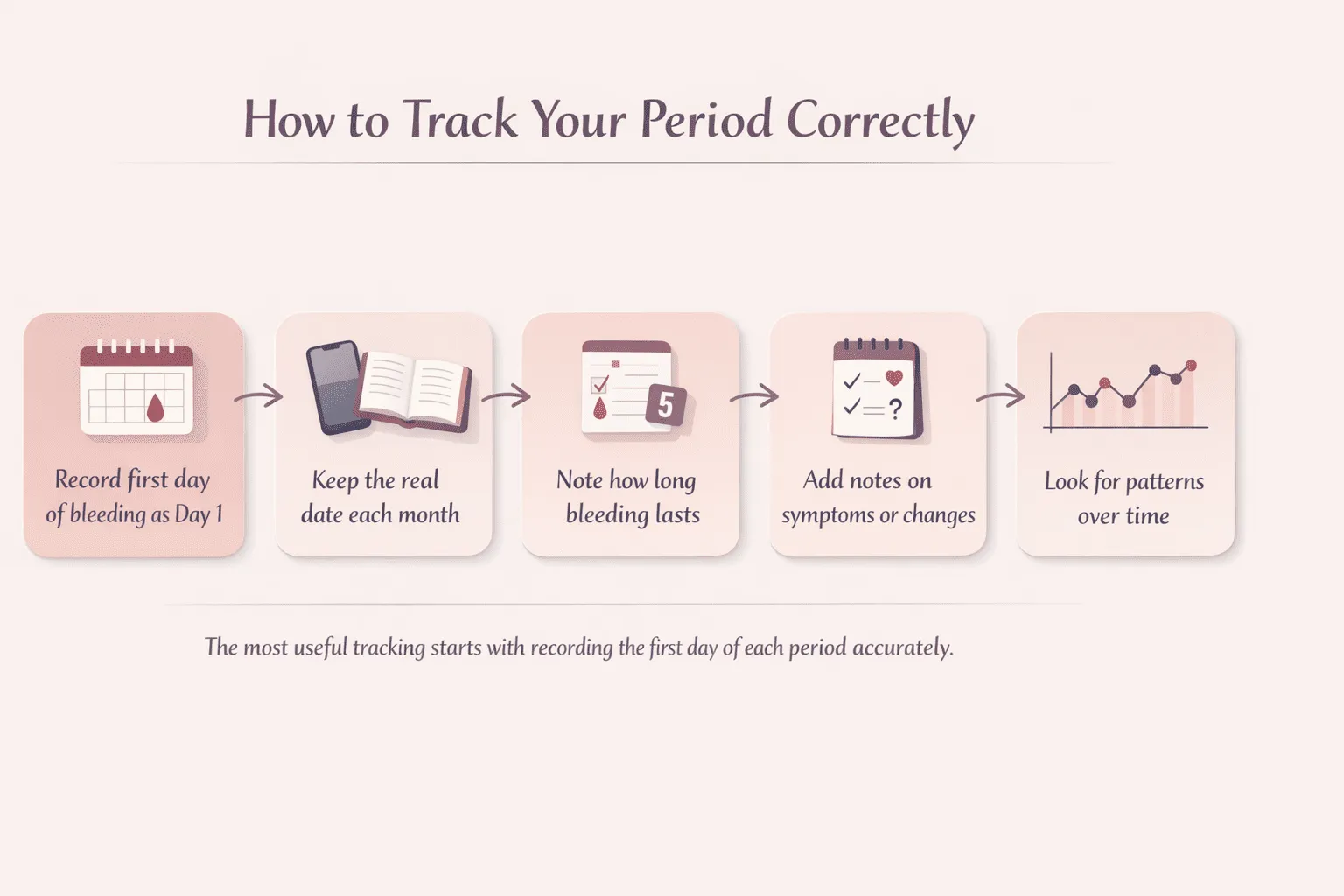
Start with the right date: day 1
The foundation of good period tracking is knowing what counts as day 1. Day 1 of the menstrual cycle is the first day of your period, and that is the date you should mark first when tracking.
This matters because most calculators measure your cycle from one period start date to the next. If you record the wrong starting point, every later estimate becomes less useful.
The first day your period starts is the anchor point for cycle tracking.
Actual dates are more useful than rough memory or guessing later.
Several months of tracking tell you much more than one cycle alone.
“I can just estimate my dates from memory later.”
Tracking works best when you record real dates consistently, especially the first day of each period.
What to record each month
The most important thing to record is the first day of each period. After that, it helps to track how long the bleeding lasts, whether the flow feels lighter or heavier than usual, and whether anything important changed that month, such as stress, illness, travel, or sleep.
You do not need to overcomplicate this. The goal is not perfect medical charting. The goal is a simple, honest record that helps you see your own pattern clearly.
Good things to track
App, diary, or calendar: what works best?
You can track your period with an app, a paper diary, or a basic calendar. An app or diary can help you see whether your timing is staying fairly consistent or becoming more irregular.
The best system is the one you will actually keep using. A simple calendar you use every month is usually more powerful than a feature-rich app you stop opening after a week.
Want your calculator results to become more useful?
Start with accurate dates, then use your tracked history to get more grounded cycle estimates.
The most common mistakes people make
One of the biggest mistakes is recording the wrong day as the start of the period. Another is relying on memory instead of writing dates down consistently. Some people also confuse cycle length with period length, which makes their records harder to interpret later.
These mistakes do not ruin tracking forever, but they do make your calculators and pattern insights less reliable.
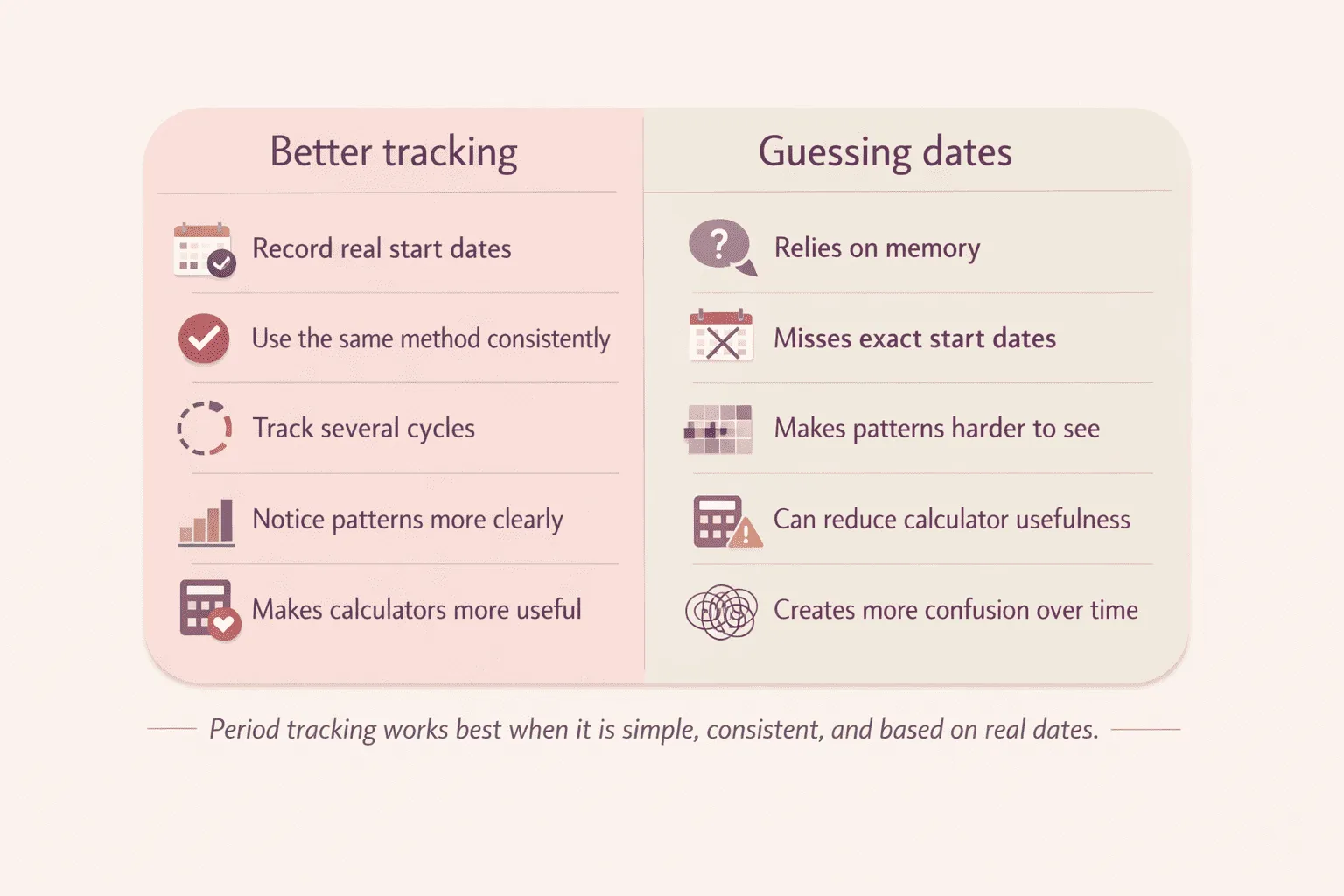
Better tracking
You record real start dates and look at several months of pattern data.
Less useful tracking
You guess dates from memory and rely on rough impressions instead of actual records.
In simple terms, tracking works best when it is consistent, date-based, and honest — not when it depends on memory alone.
Why tracking makes calculators more useful
Period tools and cycle calculators are only as useful as the information you give them. When your dates are real and consistent, the estimates are more grounded. When the inputs are vague or guessed, the result becomes much less helpful.
That is why better tracking improves not just your understanding, but also the practical value of the tools on your site.
How many months should you track?
A few months of accurate tracking usually reveals much more than one cycle alone. Patterns, average spacing, and small variations all become clearer once you can compare multiple cycles side by side.
That bigger view is also what helps you notice whether a change was a one-off disruption or the start of a broader shift.
Mark day 1 every month
This is the most important habit for useful cycle tracking.
Keep the system simple
A method you will actually keep using is better than a complicated one you abandon.
Track several cycles
Patterns become clearer when you look across multiple months instead of one isolated cycle.
Add useful context
Notes about symptoms, stress, illness, or travel can make your dates much easier to interpret later.
✦ Bottom line
Good period tracking is mostly about consistency and accuracy. If you record the first day of each period correctly and keep a simple record over several months, your patterns become clearer and your calculator estimates become much more useful.
Use your tracked dates more effectively with our Period Calculator.
Helpful next steps
Use the right next step depending on whether you want better date tracking, cycle spacing, or a clearer understanding of how to interpret your records.
Use your real tracked dates to estimate the next period more clearly.
Measure your cycle spacing more accurately from recorded start dates.
Helpful if you want to track more than dates and understand where your cycle may be heading next.
Frequently asked questions
These quick answers cover the most common questions people have when they want their tracking to be more accurate and more useful.
1What is day 1 when tracking a period?+
Day 1 is the first day your period bleeding starts. This is the key date used for measuring cycle length and for most period-tracking tools.
2What should I record when tracking my period?+
The most important thing to record is the first day of each period. It also helps to note how long bleeding lasts, how heavy it feels, and whether there were symptoms or unusual changes that month.
3Can I track my period with an app or a calendar?+
Yes. Both can work well. The best method is the one you will actually use consistently and accurately.
4Why is period tracking important?+
Tracking helps you understand your cycle pattern, notice changes more clearly, and use period calculators more effectively. It also makes it easier to describe your cycle if you ever need medical advice.
5What is the most common tracking mistake?+
One of the most common mistakes is recording the wrong day as the start of the period. Another is relying on memory instead of writing dates down consistently.
6How many months should I track before looking for a pattern?+
A few months of accurate tracking usually gives a much clearer picture than judging one cycle alone. The more consistent your records are, the easier it becomes to understand your usual pattern.
Editorial referencesSources and medical references
This guide is for educational use and should not replace personal medical advice.
+
Sources and medical references
This guide is for educational use and should not replace personal medical advice.
Good tracking is mostly about consistency: record the right dates, keep the method simple, and look for patterns over time.
Try a related tool
Start with the Period Calculator, browse the Tools Hub, or explore the Guides Hub.