
Guide
How the Fertile Window Works
The fertile window is the time in your cycle when pregnancy is most likely, but it is often misunderstood. This guide explains why it is more than one day, how ovulation affects timing, why cycle length matters, and how to use fertile-window estimates realistically.
In this guide
⚡Quick Answer
- ✦The fertile window is the part of your cycle when pregnancy is most likely.
- ✦It is not just one exact day. It usually includes the days before ovulation and the day ovulation happens.
- ✦Cycle length matters because ovulation timing can shift earlier or later depending on the pattern of your cycle.
- ✦A Fertile Window Calculator gives an estimate, not proof of the exact ovulation day.
What the fertile window actually means
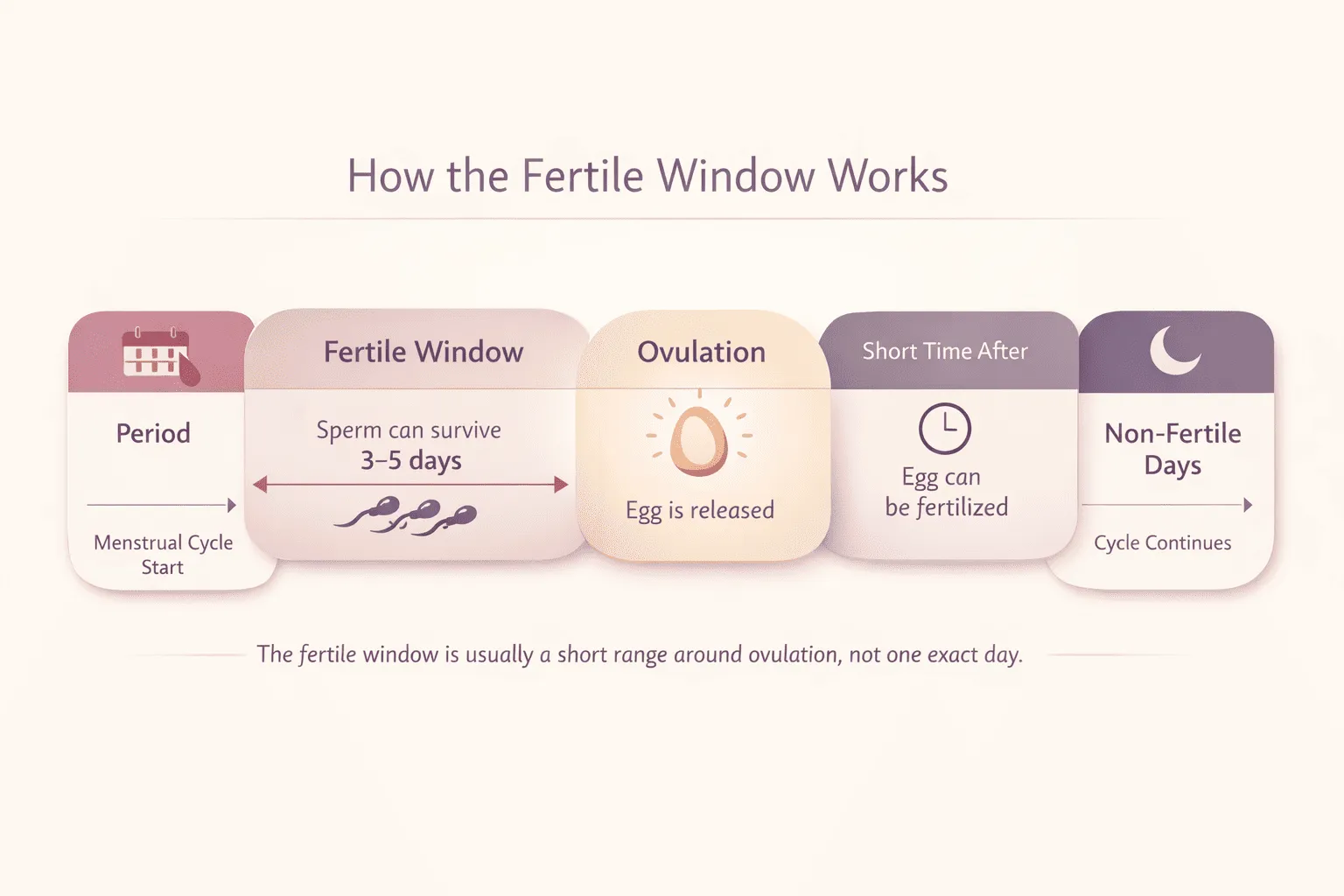
The fertile window is the stretch of time in your cycle when conception is most likely. It is wider than many people assume because pregnancy depends on more than the moment an egg is released. Sperm can survive in the reproductive tract for several days, while the egg remains fertilizable for a much shorter time after ovulation. That is why the fertile window includes days before ovulation as well as the day ovulation happens.
In practice, this means you do not need to think only in terms of one “perfect” day. A more accurate and useful mental model is a short fertile range centered around ovulation.
Fertility is often described as a window because sperm can survive for days before ovulation.
Ovulation is the key event, but conception chances are influenced by timing before it too.
The fertile window can be estimated, but real cycle timing is not perfectly predictable.
“The fertile window is just one exact ovulation day.”
The fertile window is usually a short range that includes the days leading up to ovulation and the day ovulation happens.
Why ovulation matters so much
Ovulation is when an egg is released from an ovary. Pregnancy is most likely when sperm are already present around this time. The egg can usually be fertilized for a short time after release, while sperm may survive for several days.
This is also why waiting for one exact “ovulation day” can be too simplistic. In real life, a few days of timing around ovulation matter more than one perfect calendar square.
Why cycle length changes the estimate
A very common mistake is assuming ovulation always happens on day 14. That is only a simplified example based on a textbook 28-day cycle. People with regular 28-day cycles are often taught to think about ovulation near the midpoint, but that same assumption does not apply cleanly to shorter or longer cycles. A more useful way to think about timing is in relation to the next expected period rather than one fixed day for everyone.
In practical terms, shorter cycles can move fertile days earlier, while longer cycles can move them later. That is why cycle length and tracking history matter when you use fertility tools.
What usually shapes the estimate
Want to estimate your likely fertile days?
Use your cycle information to estimate the likely range around ovulation, not just one isolated day.
Estimated fertile days are not the same as exact ovulation proof
A fertile-window calculator can be extremely useful, but it does not directly observe ovulation. It estimates likely timing from cycle information. That means the result is best treated as a planning tool, not a clinical confirmation.
This distinction matters for both trying to conceive and trying to avoid pregnancy. The window is a helpful estimate, but real bodies do not always follow a perfect calendar pattern.
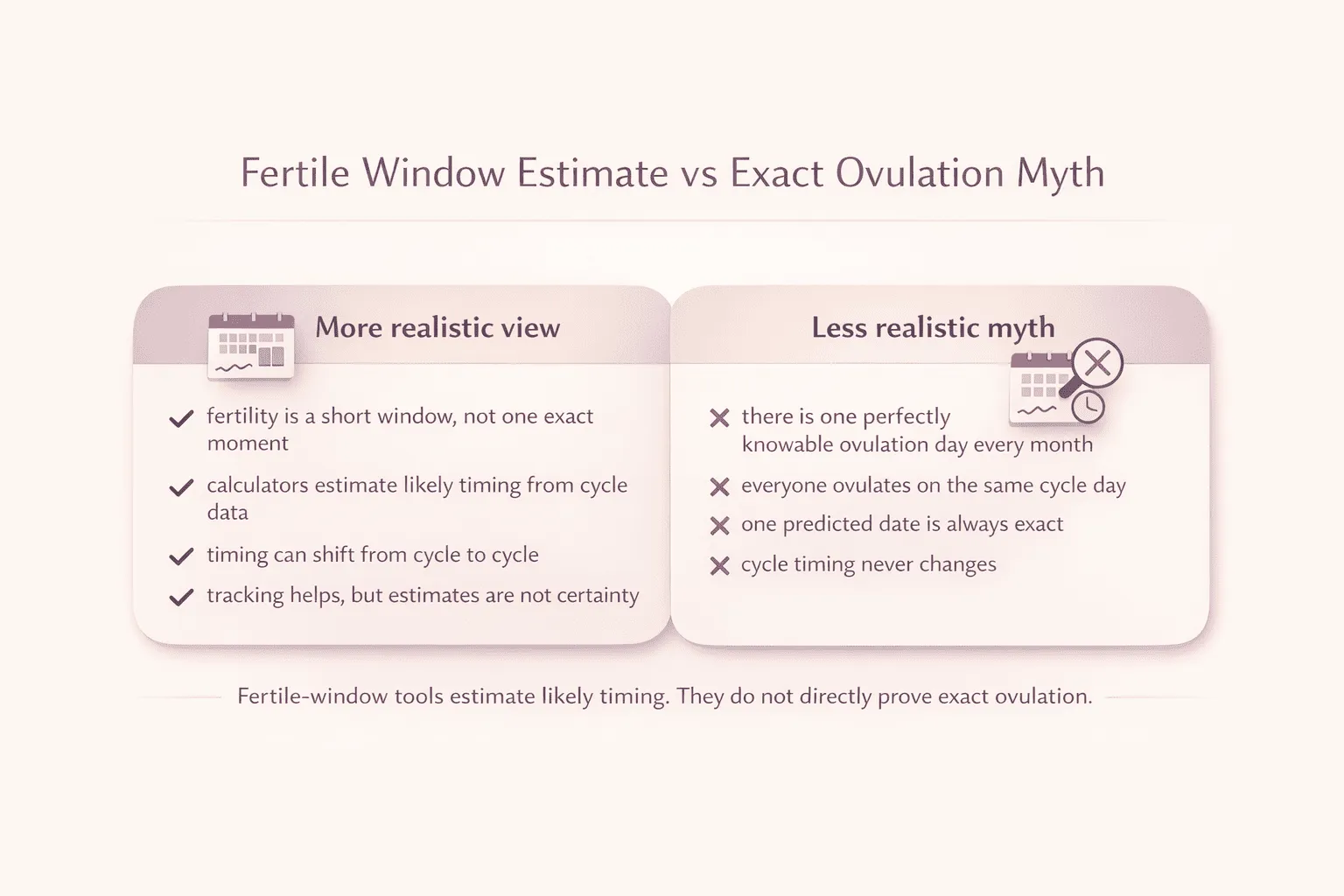
More realistic view
Fertility is a short window around ovulation, and calculators estimate that window from cycle data.
Less realistic myth
There is one perfectly knowable day that works the same way every month for everyone.
In simple terms, fertile-window tools are best used to guide timing, improve tracking, and understand patterns — not to promise one exact day with total certainty.
How to use a fertile-window estimate in a useful way
Think in ranges
A short fertile range is usually more realistic than one exact predicted day.
Track consistently
Better cycle data usually means more useful fertile-window estimates.
Use body signs as added context
Symptoms and ovulation clues can add context, but they are not all equally reliable on their own.
Be careful with false certainty
Exact-day confidence can be misleading, especially if your cycle is irregular.
When estimates become less reliable
Fertile-window estimates tend to be less reliable when your cycles vary a lot, when dates are guessed from memory, or when recent months included stress, illness, travel, poor sleep, or broader hormonal irregularity. That does not mean the estimate is useless. It simply means it should be interpreted with more caution.
Better for planning than for certainty
Fertile-window tools are excellent for learning your likely timing pattern, but they should not be treated like exact biological confirmation.
✦ Bottom line
The fertile window is a short range around ovulation, not one exact day. It can be estimated in a very useful way from cycle information, but the result is still a timing estimate — not exact proof of when ovulation happened.
Estimate your likely fertile range with our Fertile Window Calculator.
Helpful next steps
Use the right next step depending on whether you want an estimated fertile range, a more ovulation-focused timing estimate, or a deeper guide.
Estimate your likely fertile timing based on cycle information.
Use a focused estimate centered around likely ovulation timing.
Get a fuller month-by-month view of how ovulation fits into the overall cycle pattern.
Frequently asked questions
These quick answers cover the most common questions people have when trying to understand fertile timing and ovulation-based estimates.
1What is the fertile window?+
The fertile window is the part of the menstrual cycle when pregnancy is most likely to happen. It includes the days leading up to ovulation and the day ovulation happens, rather than being only one exact day.
2How many days is the fertile window usually?+
It is often described as about 6 days in total. That is because sperm can survive for several days in the reproductive tract, while the egg can be fertilized for a much shorter time after ovulation.
3Is ovulation always on day 14?+
No. Ovulation is often estimated around the midpoint in a classic 28-day example, but real cycles vary. Many health sources explain ovulation in relation to the next period, not one fixed day for everyone.
4Can I get pregnant outside the fertile window?+
Pregnancy is much less likely outside the fertile window, but everyday cycle timing is not perfectly predictable. That is why exact fertile-day claims should be treated cautiously, especially with irregular cycles.
5Does a fertile window calculator give exact dates?+
No. It gives an estimate based on cycle information. It can be very useful for planning and tracking, but it does not directly confirm the exact day ovulation occurs.
6Why does cycle length change the fertile window estimate?+
Because ovulation timing changes with overall cycle timing. Shorter cycles can move the likely fertile days earlier, while longer cycles can move them later.
Editorial referencesSources and medical references
This guide is for educational use and should not replace personal medical advice.
+
Sources and medical references
This guide is for educational use and should not replace personal medical advice.
Fertile-window tools are useful for education and planning, but they estimate likely timing rather than proving the exact day ovulation occurs.
Try a related tool
Start with the Period Calculator, browse the Tools Hub, or explore the Guides Hub.