
Guide
Can You Get Pregnant Right After Your Period? Timing Explained
Yes, it can happen — but the reason is all about timing. This guide explains why pregnancy right after your period is possible in some cycles, how shorter cycles and earlier ovulation change the answer, and why the same timing does not mean the same risk for everyone.
In this guide
⚡Quick Answer
- ✦Yes, pregnancy right after your period is possible.
- ✦It becomes more plausible when ovulation happens relatively early or when your cycle is shorter than average.
- ✦Sperm can survive for several days, so sex just after bleeding ends can still overlap with fertile timing in some cycles.
- ✦A Fertile Window Calculator can help estimate likely timing, but it does not prove the exact day ovulation happens.
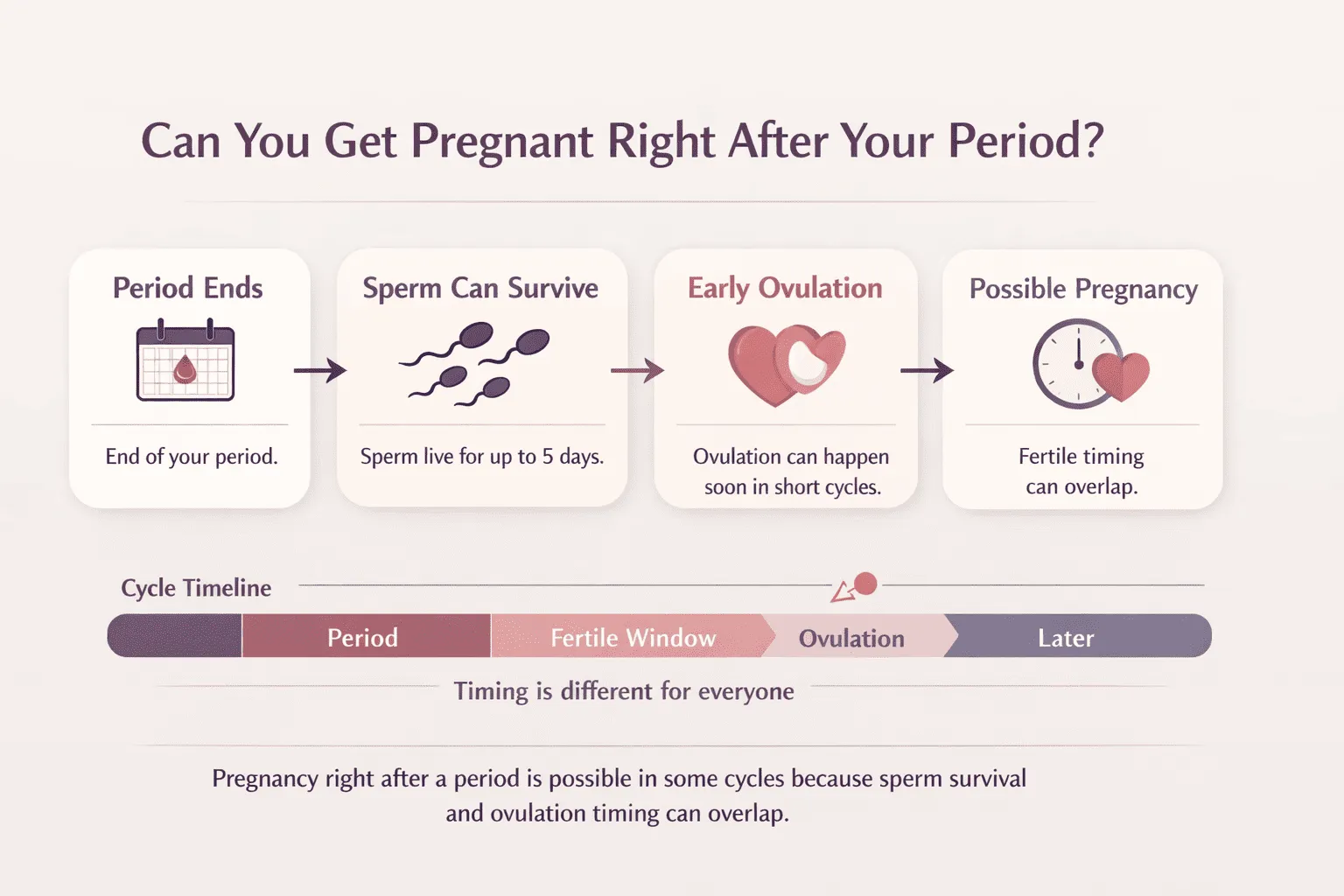
Why the answer is yes — sometimes
Many people assume the days right after a period are automatically low-risk for pregnancy. But real cycle timing is more nuanced than that. Pregnancy right after a period is possible because sperm can stay alive for several days and because ovulation does not happen on the same calendar day for everyone.
So the key question is not simply “Was it after the period?” The more useful question is: how close was that timing to ovulation?
Sperm may survive for several days, so sex does not need to happen exactly on ovulation day to matter.
Not everyone ovulates on the same cycle day, and shorter cycles can shift fertile timing earlier.
The same “right after period” timing may mean something different in different cycles.
“You cannot get pregnant right after your period.”
It can happen in some cycles, especially if ovulation comes earlier than expected or if sperm survive long enough to overlap with fertile timing.
Why short cycles make the timing more important
In shorter cycles, ovulation may happen earlier. That brings the fertile window closer to the end of menstrual bleeding. If sex happens just after the period and sperm survive long enough, pregnancy can still happen because fertile timing may arrive sooner than expected.
That is why the question often matters more in shorter or less predictable cycles than in longer, more stable ones.
What changes the answer most
Why “right after your period” does not mean the same thing for everyone
The phrase sounds precise, but it is not. For one person, “right after” may mean day 5 in a short cycle. For someone else, it may mean day 8 or day 9 in a longer cycle. Those are not equivalent from a fertility perspective.
This is one reason internet answers often sound contradictory. They are answering the same phrase while imagining very different cycle patterns.
Want a better timing estimate?
Use your cycle length to estimate when fertile timing may be closer than expected.
Short cycle vs long cycle: why the risk picture changes
A short cycle can bring fertile timing closer to the end of the period. A longer cycle may move fertile timing later. That does not mean pregnancy is impossible in one and certain in the other. It simply means the probability picture changes because the gap between period days and ovulation days changes.
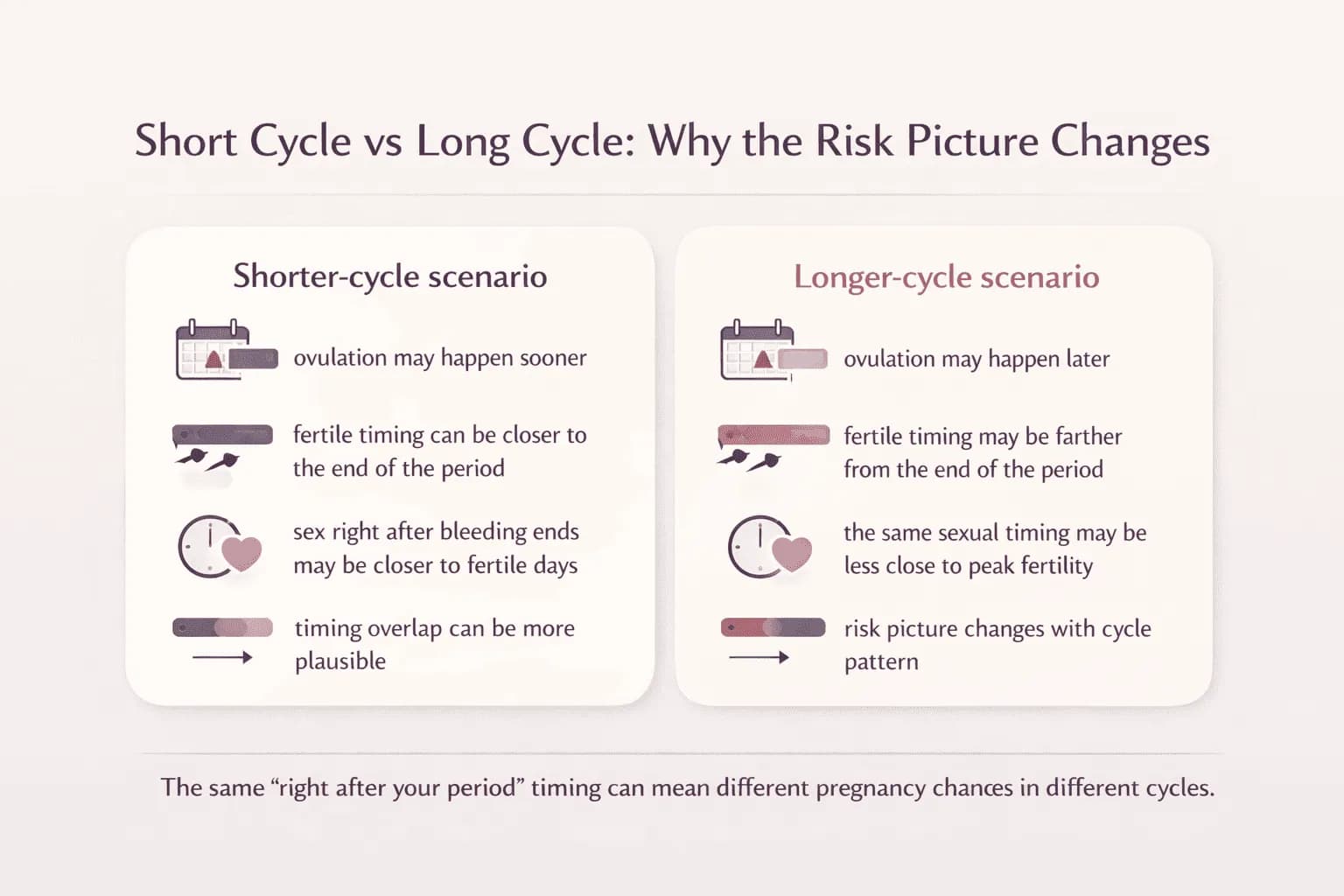
Shorter-cycle scenario
Ovulation may happen sooner, so sex right after bleeding ends can be closer to the fertile window.
Longer-cycle scenario
Ovulation may happen later, so the same timing may be farther away from peak fertility.
In simple terms, the same sexual timing can carry different pregnancy chances depending on the underlying cycle pattern.
Why “safe days” thinking can be misleading
Many people ask this question because they have heard the days right after a period are always “safe.” The problem is that those assumptions often depend on idealized cycle timing. Real cycles can shift, ovulation can happen earlier than expected, and sperm survival can extend the fertile window backward.
That is why calendar-based certainty can be risky, especially if cycles are irregular or naturally shorter.
Possible does not mean equally likely in every cycle
This guide explains why pregnancy can happen right after a period. It does not mean the same level of chance applies to everyone or to every cycle.
What to do if you want a better estimate
Track your cycle
Real cycle history gives more useful context than a guess based on one month.
Use estimate tools realistically
Fertility calculators are helpful for timing guidance, but they do not prove exact ovulation.
Be cautious with one-size rules
“Right after your period” is not one identical fertility moment for everyone.
Treat irregular cycles carefully
If timing changes often, fertile estimates become less predictable and assumptions become riskier.
✦ Bottom line
Yes, you can get pregnant right after your period in some cycles. The real issue is not whether sex happened “after a period,” but how close that timing was to ovulation and how your cycle length shapes the fertile window.
Use your cycle length to estimate likely fertile timing with our Fertile Window Calculator.
Helpful next steps
Explore timing more clearly with the right calculator or guide.
Estimate the likely fertile days in your cycle.
Use an ovulation-based estimate for more focused timing guidance.
Learn why “safe day” assumptions can break down in real cycles.
Frequently asked questions
These quick answers cover the questions people most often ask when they are unsure whether timing right after a period could still lead to pregnancy.
1Can you get pregnant right after your period?+
Yes, it is possible. It may be less likely in some cycles, but pregnancy can still happen if ovulation occurs relatively early or if sperm survive long enough for fertile timing to overlap with the days just after bleeding ends.
2Why does a short cycle increase the chance?+
In a shorter cycle, ovulation may happen earlier. That can bring the fertile window closer to the end of a period, which increases the chance that sex right after the period could still lead to pregnancy.
3Does having sex during or just after a period always mean pregnancy is likely?+
No. Possible does not mean highly likely in every case. The answer depends on cycle timing, ovulation timing, sperm survival, and whether your cycle is regular or more variable.
4If my periods are irregular, is the timing harder to predict?+
Yes. Irregular cycles make it harder to predict when ovulation might happen, which also makes fertile timing less certain. That is one reason exact assumptions can be misleading.
5Is this why safe-day assumptions can be risky?+
Yes. If someone assumes the days right after a period are always safe, they may overlook early ovulation, shorter cycles, or sperm surviving longer than expected.
6What should I use if I want a better estimate?+
A Fertile Window Calculator or Ovulation Calculator can help estimate likely timing, but the result should still be treated as guidance rather than exact proof of ovulation.
Editorial referencesSources and medical references
This guide is for educational use and should not replace personal medical advice.
+
Sources and medical references
This guide is for educational use and should not replace personal medical advice.
Pregnancy timing depends on ovulation, sperm survival, and cycle variation — not just whether sex happened before, during, or after visible bleeding.
Try a related tool
Start with the Period Calculator, browse the Tools Hub, or explore the Guides Hub.